Property Management in Montevallo, Alabama
Key Takeaways
- Rental property does not decline all at once — it declines through deferred repairs that compound into system failures, late payments accepted without consequence that become patterns, and move-outs documented carelessly that become security deposit disputes the owner cannot win because the evidence was never gathered.
- A multi-family building operates as a system where one lease left unenforced signals to every other tenant in the building that the lease is optional — and the assumption that Section 8 housing is simpler to manage than market-rate property is one of the most expensive misunderstandings a rental owner in Montevallo can carry into the work.
- Lease Birmingham LLC manages the full discipline of that exposure — leasing with standards, screening with rigor, collecting with consistency, inspecting with documentation, repairing with judgment, and enforcing with the follow-through that keeps the asset performing and the rent roll intact across Montevallo and Shelby County.
The Ground Beneath the Investment
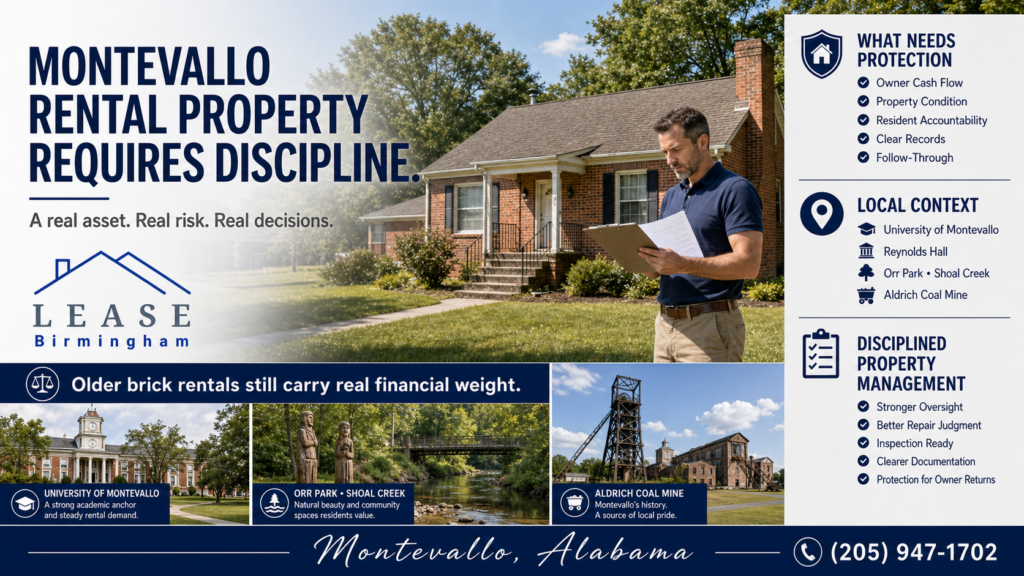
There is a particular quality to the air above Shoal Creek — cool and unhurried, moving between the old oaks the way it has moved for two centuries, carrying the memory of coal smoke and railroad iron and the slow, deliberate work of people who built things meant to last. The town sits where its name says it sits: on a mound in a valley, tucked into the hills of Shelby County thirty miles south of Birmingham, old enough to carry consequence, small enough to feel it in the bones. The University of Montevallo rises above the surrounding streets with the quiet authority of seventy-three buildings on the National Historic Register — Reynolds Hall among them — looking out over a campus that has stood since the Alabama Legislature established it in 1896 and shows no interest in retreating. Down the road from the university grounds, Orr Park follows the bend of the creek; Timothy Tingle carved figures into the dead cedar trees along the walking trail there; and those figures watch the path with a patience that no distracted property owner has ever managed to match.
This is a city of real things. Real history. Real brick. Real wood. Real financial exposure for every person who holds a deed inside its borders and does not pay close enough attention to what that deed actually requires of them.
The question worth asking — before a single lease is signed or a single repair is authorized — is this: who is actually watching that exposure?
What the Deed Actually Requires
A rental property does not hold its value by accident; it holds its value because someone makes consistent, judgment-driven decisions about the lease, the tenant, the maintenance, the documentation, and the enforcement. Remove that consistency and the property does not stay neutral — it declines. Slowly at first: a repair deferred here, a late payment accepted without consequence there, a move-out documented carelessly because no one thought it would matter. Then faster. The deferred repair becomes a failed system. The accepted late payment becomes a pattern the tenant now relies on. The undocumented move-out becomes a security deposit dispute that cannot be won because the evidence was never gathered.
This is not a dramatic scenario. This is the ordinary result of property management that runs on goodwill instead of process.
The owner who manages alone in a market like this one learns these lessons at full cost: the cost of vacancy days that accumulated while the listing waited; the cost of a tenant placed without proper screening who tested the lease from month two onward; the cost of a contractor who charged retail rates because the owner had no frame of reference for what a repair should cost; the cost of a legal situation that became serious because the lease language was weak or the documentation was absent. These are not exceptional outcomes reserved for careless people. They are standard results when the work is done without a system — and that distinction matters because the market does not care which category any individual owner falls into.
The Single-Family Home Is Not a Passive Asset
There is a persistent and expensive misunderstanding among rental property owners — the belief that a single-family home, once occupied, largely manages itself. That the rent will come in. That the tenant will report problems honestly. That the lease will hold its meaning without enforcement. That the property will hold its condition without regular inspection.
None of this is true. A single-family home in a university city with rotating tenants and historic housing stock requires active management at every stage of the occupancy cycle: precise screening before the lease is signed; clear documentation at move-in and move-out; maintenance response fast enough to prevent small problems from compounding and disciplined enough to avoid paying for unnecessary work; and lease enforcement consistent enough that the tenant understands the document means what it says.
What drives retention and rent performance in this market is the quality of the occupant placed and the consistency of the management that follows. Those who understand what residential property management in Montevallo actually demands do not leave screening to instinct or enforcement to goodwill; they run the process correctly from the first showing to the final walkthrough; and the financial result of that discipline shows in a rent roll that holds and a property condition that does not erode behind the scenes while the owner assumes everything is fine.
The house that was purchased as an income-producing asset does not forgive the owner who stops treating it like one. The deferred inspection that missed the slow leak under the kitchen sink becomes a subfloor replacement six months later. The tenant placed on instinct rather than documented qualification becomes a thirty-day notice of eviction by spring. The lease that was never enforced when the first violation occurred becomes a lease that cannot be enforced at all — because the pattern of non-enforcement is now the actual standard. These are not hypothetical consequences. These are the specific costs of self-management in a market that moves faster than any distracted owner can track.
The Multi-Family Building and the Cost of Weak Standards
A multi-family building does not operate like a scaled-up single-family home; it operates like a system — one where every unit is connected to every other unit not through walls alone but through standards; where a lease not enforced in one apartment signals to every other tenant in the building that the lease is negotiable; where a maintenance issue deferred in one unit communicates to the rest that deferred maintenance is the expectation; where vacancy in one unit creates pressure on the rent roll of the whole building while the owner waits to address whatever caused it.
The financial case for disciplined multi family property management in Montevallo is built on this reality: a building that runs with consistent standards retains tenants and holds rent; a building that does not loses both; and the cost of recovering a building that has drifted from its standards is substantially higher than the cost of maintaining them from the beginning. The gap between a building managed with precision and a building managed with good intentions is measured in dollars — in the rent that walked out with the reliable tenants who found somewhere better run; in the repairs that compounded because no one caught them during a scheduled inspection; in the legal exposure that grew because the lease was enforced selectively rather than consistently.
Managing a multi-family property correctly means tracking multiple lease cycles simultaneously without losing precision on any one of them; means communicating with multiple tenants without allowing response time to become the expectation they measure the building against; means making repair decisions that protect the physical asset without approving costs the situation does not require. This is judgment work. The operator who does it well holds the building together; the operator who does it poorly watches the building come apart one unaddressed situation at a time — and the owner absorbs every dollar of that deterioration whether they know it is happening or not.
The Real Work Behind Affordable Housing
The assumption that Section 8 housing is simpler to manage than market-rate housing is one of the more expensive misunderstandings in property management. It is not simpler. It is different — and in ways that punish operators who are not prepared for it.
Housing assistance units operate under a layer of regulatory requirements that market-rate units do not. Inspections are not optional and not forgiving; a unit that fails inspection loses the housing assistance payment while corrective work is completed and the owner absorbs the cost of that gap. Paperwork must be precise and submitted on schedule. The housing authority does not accommodate errors made from ignorance of the process — the payment simply stops and the owner is left to figure out why.
What serious Section 8 property management in Montevallo requires is the same discipline applied to any other capital asset: proper documentation from the beginning; maintenance response fast enough to pass inspection and keep the unit in the condition the program requires; screening that identifies tenants capable of sustaining a successful tenancy; and the administrative precision to keep the regulatory relationship with the housing authority in good standing. The owner who brings that discipline to affordable housing finds that the payment is reliable and the tenancy is stable. The owner who underestimates the work finds out what the gap between expectation and reality actually costs — and the education is not cheap.
There is nothing lesser about housing a working family in a well-maintained unit with a lease that is enforced and a landlord who answers the phone when something breaks. That is the obligation of the work regardless of the funding source — and the operator who cannot meet that obligation in the affordable housing space should not be operating in it.
The Discipline That Protects the Asset
What gets protected through serious property management is not just the rent check — it is the underlying value of the asset; the condition of the structure that produces that rent check; the legal standing of the lease that obligates the tenant to produce it; and the long-term financial position that makes the whole arrangement worth holding.
The work that does that protecting is not complicated in concept: lease correctly; screen rigorously; collect consistently; inspect with documentation; repair with judgment; report with clarity; enforce with follow-through. Each one of those functions has a financial consequence when it fails. Leasing without standards produces tenants who underperform. Screening without rigor places the wrong occupant in a property that will reflect that choice for months. Collecting without consistency trains tenants that the due date is a suggestion. Inspecting without documentation leaves the owner without recourse when the move-out dispute arrives. Repairing without judgment wastes capital the owner earned. Reporting without clarity keeps the owner blind to the actual condition of the investment. Enforcing without follow-through signals that the lease is optional.
None of that is acceptable. None of it should be tolerated by an owner who understands that rental property is not a passive vehicle but a capital asset that requires active stewardship to perform — and that the market will extract payment from any owner who treats it otherwise.
What the Decision Actually Protects
The argument for serious property management is a financial argument — not a comfort argument, not a convenience argument. It is the argument that a capital asset managed with discipline outperforms the same asset managed without it; that the cost of professional management is recovered in reduced vacancy, stronger tenant quality, avoided legal exposure, and property condition that holds rather than erodes; that the owner who treats the investment seriously produces better returns from it than the owner who does not.
The question worth confronting honestly is this: what is the cost of weak management? Not in theory — but in practice. In the actual dollars spent on deferred maintenance that compounded. In the actual rent lost to vacancy that could have been shortened with faster action. In the actual damage left behind by a tenant who should never have been placed. In the actual legal exposure created by lease language that did not hold when it needed to.
Those numbers are real. They show up in the ledger whether the owner wants to look at them or not.
The full scope of what gets covered under property management in Montevallo extends from the first leasing call to the final move-out inspection and every judgment call between those two points: tenant communication managed with consistency; maintenance authorized with awareness of cost; owner reporting delivered with enough precision to support real decisions; and the kind of long-view discipline that keeps an asset performing year after year in a market that has no patience for operators who are not paying attention.
The Call That Changes the Position
Rental property in Shelby County does not wait for its owner to become ready. The lease turns when it turns. The maintenance request arrives when it arrives. The tenant tests the lease when the tenant decides the lease is worth testing. The property deteriorates at exactly the rate that deferred maintenance and inattention allow.
The city of Montevallo — with its university cycle, its historic housing stock, its mix of long-term residents and rotating tenants shaped by the rhythms of academic life — presents the specific challenges that any market with moving parts presents: turnover, maintenance cycles, screening complexity, and the particular financial exposure that comes with any property sitting between a paying tenant and a declining condition. The Aldrich Coal Mine that once ran beneath these hills was not worked carelessly; the people who built Reynolds Hall did not use inferior materials and hope for the best. The same standard applies to every investment made inside these borders.
The owner who is ready for all of it — who has a process behind every function and a standard behind every decision — holds the asset in the condition it deserves and collects the return it is capable of producing. The owner who is not ready pays for that unreadiness in ways that compound.
The next step is not complicated. Contact Lease Birmingham. Describe the property. Have the conversation about what the asset requires and what protecting it actually looks like in execution — not in a brochure, not in general terms, but in the specific, documented, judgment-driven work that a serious investment demands.
The lease gets written correctly. The tenant gets screened correctly. The rent gets collected on schedule. The property gets inspected with documentation. The repairs get authorized with judgment. The owner gets reporting that reflects reality.
That is the work. That is what protecting the investment actually looks like — not in theory, but month after month, property after property, in a city that has been watching people build and lose and rebuild since Jesse Wilson first broke ground above Shoal Creek.
Make the call. The cost of not doing it is already running.