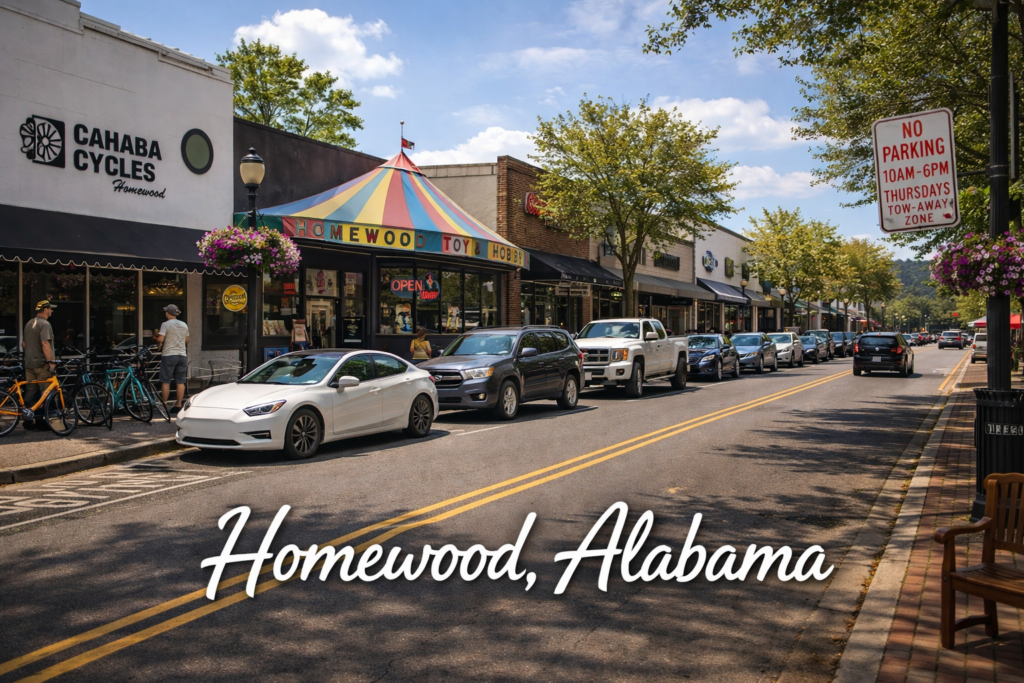
Property Management in Homewood, Alabama
Key Takeaways
- Lease Birmingham LLC provides residential, multi-family, and Section 8 property management in Homewood, Alabama with leasing oversight, maintenance coordination, rent collection, and resident communication.
- The Homewood narrative centers on visible local settings such as Shades Creek Greenway, Central Park, SOHO Square, and the Hollywood Historic District, reinforcing the need for attentive management in a high-expectation market.
- The content emphasizes owner relief through consistent operations, inspection readiness, clear documentation, legal awareness, and stable housing standards across traditional rentals and affordable housing.
Where Homewood Keeps Its Character
Homewood does not walk into a room; Homewood hums before it arrives. It comes with the soft rush of traffic along familiar roads, with storefront light in the evening, with joggers and strollers moving near Shades Creek Greenway, with the kind of daily life that looks easy from the outside and takes real effort to keep steady. This is not a place that feels accidental. It feels built by habit, by memory, by people who like a town that still acts like a town even while the larger pull of Birmingham presses close at the edge. Homewood grew from separate communities such as Edgewood, Rosedale, and Grove Park before those places merged into one city in 1926; Hollywood joined in 1929, and that layered past still shows in the shape and mood of the place.
Walk through Homewood and the whole area seems to carry on a quiet conversation with itself; one block offers polished shop windows and the brisk movement of modern errands, another block settles into older streets where porches, brickwork, and mature trees seem to hold a longer memory. SOHO Square gives one kind of pulse to the city, public and lively and full of people crossing paths; the Hollywood Historic District gives another, with homes from the 1920s and 1930s known for Mission Revival and Spanish Colonial Revival design; Shades Creek Greenway lays out a different kind of sentence entirely, a trail that runs beside the floodplain of Shades Creek and reminds anyone paying attention that even in a busy metro area, water and shade and open air still have their say. Central Park adds its own note with green space, walking paths, pavilions, an amphitheater, and the ordinary civic grace of a place where people gather without needing a grand occasion.
That is the feeling of Homewood; not loud, not sleepy, not trying too hard, yet never asleep at the wheel. It has history without becoming a museum; it has energy without giving itself over to chaos. Streets here know the rhythm of school drop off, dinner reservations, quick coffee, dog walks, lease renewals, roof inspections, package deliveries, vendor calls, and all the small human business that makes a neighborhood feel real. A rental house in such a place is never just a structure with walls and locks; it sits inside a living system. A duplex, a townhome, an apartment building, a Section 8 unit, a single family rental with a shaded yard and a stubborn gutter; each one stands in the weather, in the market, in the flow of everyday life, asking the same blunt question: who is going to keep all of this in order when real life gets busy?
That question is where Property Management in Homewood stops sounding like a search phrase and starts sounding like relief.
When the Rental Starts Running the Owner
There is a version of ownership that people imagine in bright colors; rent comes in, the asset grows, the future looks organized, and a person feels wise for having bought a piece of something solid. Then there is Tuesday at 9:14 p.m.; a message about water where water should not be, a tenant unsure whether a flicker is a bulb or a breaker, a lease issue that looked simple until two pages of law and one page of misunderstanding turned it into a mess. The work does not always arrive in one dramatic crash. More often it appears like dust; a little here, a little there, until the whole desk is covered.
A property owner trying to handle everything alone can end up chained to the smallest things; the lock that needs rekeying, the invoice that needs checking, the question about notice periods, the call from a vendor who can come on Thursday but only after lunch, the photo of a ceiling stain that might be old or might be the first sign of a much bigger problem. The phantom of maintenance does not kick down the front door with a speech and a spotlight; it slips in through timing, through neglect, through one postponed repair that suddenly drags five more behind it. The fog of legalities behaves the same way. It settles low; it clouds judgment; it makes ordinary decisions feel heavier than they should.
A landlord may begin with confidence and still wind up buried under cluttered ledgers, half answered messages, rushed decisions, and one hard truth that comes for every do it alone system sooner or later: no property stays calm just because a person means well. Calm has to be built. It has to be scheduled, documented, repaired, enforced, and checked again. Rent has to be collected with consistency. Maintenance has to be handled before frustration turns into resentment. Screening has to be careful. Communication has to be clear. Standards have to stay standards even on tired days.
This is especially true in a place like Homewood, where expectations tend to be high because the setting is high quality. Residents notice when details slip. Owners feel it when vacancies stretch. Neighbors feel it when a building loses order. A city with historic districts, active parks, well used public spaces, and a strong sense of local identity does not hide poor management for long.
Residential Property Management
Single family homes ask for a kind of respect that goes beyond the spreadsheet. These are the places where routines take root; backpacks land by a door, groceries hit the counter, a lamp glows in the same corner every evening, and the whole structure becomes part shelter, part habit, part memory machine. A house may be an investment on paper, but in reality it holds noise, silence, recovery, celebration, stress, and sleep. Good residential management understands that truth without becoming sentimental about it.
Lease Birmingham approaches residential service with a steady eye and a practical hand. The job is to protect condition, income, order, and dignity all at once; not one at the expense of the others. That means careful leasing, clear expectations, prompt attention to repair issues, follow through with vendors, documentation that does not drift into sloppiness, and communication that does not leave an owner guessing or a resident stewing. It means seeing a small issue while it is still small. It means understanding that a missed detail at turnover can echo for months. It means remembering that a house cannot speak, so management has to listen on behalf of the house before damage learns to talk louder.
In Homewood, this matters. A rental home near established neighborhoods and well loved public spaces is part of a visible streetscape; people notice upkeep, rhythm, and respect. A neglected property does not sit alone in embarrassment; it drags on the feeling of a block. A well managed property, by contrast, settles into the area with confidence. Grass gets handled. Repairs get handled. Residents know where to turn. Owners are not trapped in constant reaction. The whole arrangement gains something rare in rental work; steadiness.
That is what strong Residential Property Management in Homewood should look like for single family assets. Not flashy promises. Not hard sell language. Just the kind of reliable oversight that keeps a home clean in process, cared for in practice, and protected through the ordinary wear of real life.
Multi Family Property Management
Then there are the larger dwellings; the apartment communities, the small multifamily clusters, the buildings where many front doors stand near one another and every decision travels faster because more people feel the effect. These are the great hives of modern living; busy, layered, efficient when managed well, exhausting when managed poorly. In one corner there is a maintenance request; in another, a parking complaint; above, a noise concern; below, a move out; in the office, a lease file that needs exact handling; in the numbers, a vacancy that wants attention before it becomes a habit.
Harmony in a multifamily setting does not happen by accident. It takes rules that are enforced with consistency, repairs that are handled without drift, common areas that stay orderly, and communication that does not create confusion where calm was needed. A weak grip in one area spreads trouble through the rest. Delay on maintenance weakens resident trust. Inconsistent enforcement weakens community order. Poor screening weakens the entire building. Before long, one problem has a cousin in every hallway.
Lease Birmingham brings structure where drift likes to grow. That means systems for rent collection, vendor coordination, resident communication, turnover readiness, issue tracking, and day to day oversight that keeps the community from tipping into disorder. It means understanding that a multifamily property is both business and environment; numbers matter, but so does atmosphere. Residents can feel whether a place is being watched over with care or merely pushed through a routine. Owners can feel it too, especially when reports come in clean, decisions stay grounded, and the property no longer lurches from one fire to the next.
In Homewood, where people move between parks, restaurants, shops, schools, and established neighborhoods with a strong expectation of order, Multi Family Property Management cannot be loose or sleepy. A building has to function; it has to stay responsive; it has to look and feel under control. When that happens, residents stay longer, tension stays lower, and ownership becomes less of a constant scramble.
Affordable Housing and Section 8 Property Management
There is nothing minor about affordable housing. It is serious work because shelter is serious work. A roof that leaks over a family does not become less urgent because a program stands behind the rent. A door that does not lock right does not become a small matter because the paperwork has more steps. In fact, the work grows more important, because the margin for disorder is often smaller and the need for competence is greater.
Section 8 property management calls for patience, accuracy, responsiveness, and plain human decency. It requires a manager who can keep standards high, timelines clear, communication direct, and property condition where it needs to be. It asks for someone who understands inspection readiness, documentation, resident issues, maintenance follow through, and the fact that affordable housing is not lesser housing. It is housing, full stop. It deserves professional attention, clean systems, and respect.
Lease Birmingham treats this work with the seriousness it deserves. Section 8 Property Management in Homewood is not presented as a side lane or a reluctant service; it is part of responsible management. The goal is simple in the best sense of the word; stable homes, compliant operations, responsive maintenance, and clear processes that help owners stay on track while residents live in units that are safe, functional, and cared for. That means roofs that hold, plumbing that works, heat and air that perform, doors that shut right, and communication that does not vanish when questions become inconvenient.
There is a moral dimension to this work, but there is also a practical one; disorder helps no one. Neglect harms residents, harms owners, harms neighborhoods, and invites avoidable conflict at every level. Proper Section 8 Property Management in Homewood helps keep housing stock viable, expectations clear, and rental operations grounded in accountability rather than improvisation.
Lease Birmingham as a Watchful Custodian
Lease Birmingham stands in this picture not as a distant office with polished phrases, but as a watchful custodian; present, alert, and grounded in the real mechanics of rental housing. The task is not to decorate the truth. The task is to shoulder the truth of management before it turns into trouble for an owner.
That means watching the details that quietly shape performance; lease compliance, maintenance coordination, resident communication, vendor follow through, collection processes, turnover preparation, documentation, and the hundred small acts of attention that separate a healthy property from one that always seems to be slipping. It means guarding the interests of the owner while keeping the property fit for the people living inside it. It means staying awake to the practical reality that ownership should not require midnight panic, legal guesswork, or a private second job built out of email chains and repair calls.
A good manager does not erase responsibility; a good manager carries the right portion of it with discipline. That is the difference. With Lease Birmingham, an owner does not have to stare at every leak, every form, every missed payment, every scheduling puzzle, and every resident issue as though each one were a fresh personal crisis. The property is being watched. The moving parts are being handled. The structure around the investment is not left to luck.
And in a place like Homewood, where the daily standard feels high even in the smallest details, that kind of custody matters. It matters near the walking paths and pavilions of Central Park. It matters near the movement and visibility of SOHO Square. It matters on quieter streets, older streets, busier streets, and in those pockets where history still lingers in the walls and trees. Good property management lets a property belong to the city without becoming a burden on the owner.
A Final Invitation
If you own rental property in Homewood, there is no prize for carrying every burden alone; no medal for answering every late call, chasing every invoice, second guessing every notice, or learning every lesson the hard way. There is only time spent, energy burned, risk increased, and peace traded away piece by piece.
Lease Birmingham is ready to step into that weight and make it orderly.
Bring the single family home that needs steady oversight. Bring the multifamily asset that needs rhythm and control. Bring the affordable housing unit that deserves careful compliance and real care. Bring the questions, the backlog, the uncertainty, the long list, the tired ledger, the maintenance trail, the vacancy concern, the legal unease, and the simple desire to stop feeling pulled in ten directions at once.
Let Lease Birmingham take up the daily watch.
Let the property be managed with clarity.
Let the work be done with discipline.
Let peace return to the picture.