Property Management In Trussville, Alabama
Key Takeaways
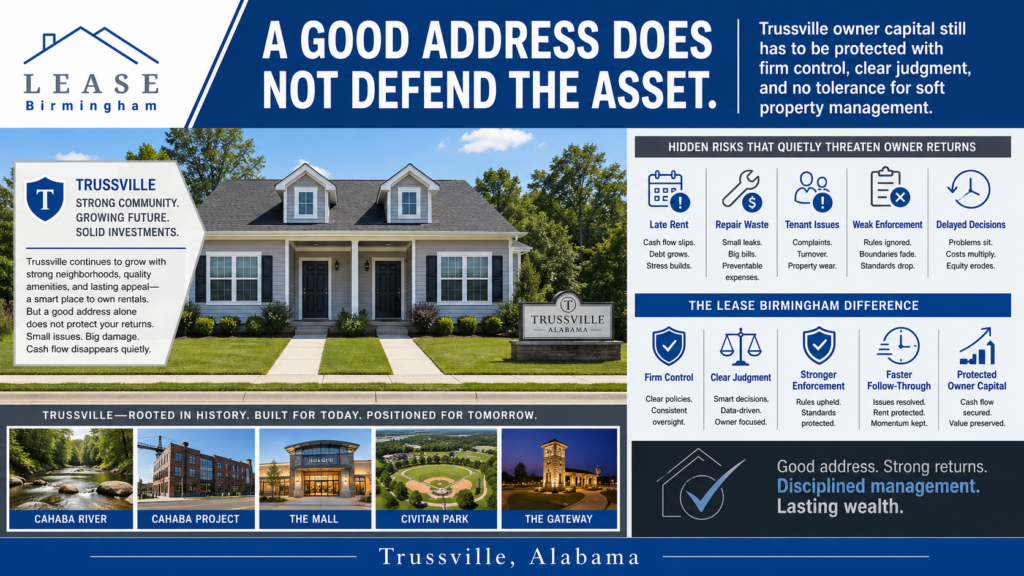
- The Cahaba River, the Cahaba Project, The Mall, Civitan Park, and The Gateway give Trussville its sense of place, but the hard lesson stays financial: a strong local setting cannot collect rent, challenge invoices, document tenant conduct, or stop a repair from becoming a larger loss.
- Trouble inside a Trussville rental rarely announces itself as disaster; it begins as a late payment, a polite excuse, a small repair, a loose rule, or a quiet vacancy, then keeps taking money until someone with discipline forces the property back under control.
- Single-family homes, multi-family buildings, and voucher-backed rentals each fail in different ways when handled softly, which is why Lease Birmingham LLC is framed as the property management company protecting owner capital before delay, repair waste, weak enforcement, and poor documentation become permanent damage.
Where The Cahaba Still Has A Long Memory
Along the bend of the Cahaba River, where the water moves with the patience of something older than every roofline and road sign around it, Trussville carries a particular kind of order; not the brittle order of places polished for display, not the sleepy order of towns that have surrendered ambition, but the lived-in order of a city that grew from labor, homebuilding, family routine, and the steady belief that a decent place to live should be held together with more than good luck.
The Cahaba Project still gives the place a backbone. Those historic homes and shaded streets near The Mall speak in a plain, durable language; a home has meaning, a neighborhood has weight, and a property that is not watched will begin, in small and expensive ways, to betray the people depending on it. Civitan Park gives the city green breathing room, The Gateway pulls modern downtown life into motion, and across the whole place runs that familiar Alabama mixture of church mornings, school traffic, full restaurants, late workdays, old memory, new pressure, and houses that look peaceful until a repair call, a tenant dispute, or a missed payment begins knocking at the back door.
This is where rental ownership becomes serious. A house in a good city does not protect itself. A duplex with a clean exterior does not guarantee a clean ledger. A small apartment building near a strong rental pocket does not keep order by charm alone. The city may be growing, busy, and desirable, but growth does not collect rent, answer maintenance calls, document tenant conduct, question a vendor invoice, handle a renewal, or stop a small leak from becoming a ruined ceiling.
For that reason, owners who need Property Management in Trussville are not shopping for soft promises; they are looking for a disciplined hand between the property and the thousand small forces that eat cash flow when nobody stands guard.
A Good Address Can Still Become A Bad Month
Every rental begins with a story the owner wants to believe. The numbers look sensible. The house looks presentable. The rent seems strong. The tenant appears reasonable. The repair list feels contained. The first month gives no warning loud enough to frighten anyone.
Then the ordinary trouble begins.
A payment arrives late, but the explanation sounds human. A small repair appears, but the vendor makes it seem harmless. A tenant asks for patience, and patience feels cheaper than conflict. A gutter clogs, a drain slows, a smoke detector chirps, a lease clause needs enforcement, a move-out date approaches, and the owner starts carrying the property in the mind during dinner, during work, during the hour that should have belonged to rest. Nothing has collapsed, yet the month has already begun pulling back.
That is the cruel trick of rental property. Loss rarely enters with a brass band. It steps in quietly, wipes its feet on the mat, and begins rearranging the furniture. A late fee waived once becomes an expectation. A repair approved without enough detail becomes an invitation. A tenant issue left undocumented becomes an argument. A turn handled too slowly becomes vacancy drag. A weak renewal becomes another year of thin margin.
No owner should mistake quiet for control. Quiet can mean the file is clean, but quiet can also mean the problem has not yet become loud enough to demand attention. The difference is property management discipline.
The House That Looks Calm From The Street
A single-family rental in Trussville can fool a person from the curb. The lawn may be cut, the porch may sit neat in the afternoon sun, and the windows may reflect the sky as if nothing inside could possibly be wrong; yet behind that ordinary calm sits the real work of Residential Property Management. The rent ledger has to be watched. The condition has to be protected. The tenant relationship has to remain clear. Maintenance has to be questioned with judgment, not approved out of exhaustion.
The work matters because a house is not merely one tenant household and one monthly payment. It is a roof that must hold, a floor that must survive use, plumbing that must behave, appliances that must not become recurring drains, and a lease that must mean what it says. When a single-family rental is handled with soft habits, the property begins collecting little injuries. Some are financial. Some are physical. Some are legal. Some are reputational. All of them have a cost.
A disciplined manager looks at the same house differently than a tired owner looks at it. The question is not simply whether a repair has been requested; the question is whether the repair is necessary, whether the cause is clear, whether the price makes sense, whether the issue has appeared before, whether tenant conduct is involved, and whether delay will make the final bill worse. The question is not simply whether rent came in; the question is whether the pattern is stable, whether the file is documented, whether the lease terms are being treated as rules or suggestions, and whether the owner is being protected before a small failure becomes a larger habit.
That is where Lease Birmingham belongs in the story; not as decoration around a rental, not as a pleasant voice between two parties, but as the firm operating hand that keeps the property from drifting.
Several Doors Under The Same Weather
A multi-family property carries more motion, more noise, more opportunity, and more danger. One roof may cover several lives. One shared wall may divide two very different standards of living. One unresolved leak may cross from one unit into another. One tenant conflict may unsettle the whole building. One weak decision may travel through the property faster than any written notice.
Apartment living has always had the feeling of a crowded hive; not in a cold or insulting sense, but in the plain reality that many people living close together require order if peace is going to last. Parking habits, noise, trash, exterior condition, shared areas, repair timing, rent collection, and renewal decisions all matter because a multi-family property does not keep problems contained for long. The building remembers every loose rule.
For buildings with several doors under one roof, Multi-Family Property Management in Trussville begins where pressure begins. One vacant unit weakens the income picture. One neglected exterior tells good tenants the standard has slipped. One tenant allowed to bend the rules teaches every other door that order has become negotiable. A building with many lives inside it must be held with a firm, even hand, because every soft decision travels farther than the unit where it began.
A strong multi-family property should be run with calm pressure. Tenants should know the rules without having to guess whether those rules matter. Vendors should know that invoices will be read carefully. Repairs should be handled in a way that protects both condition and margin. Owners should receive clear information, not fog wrapped in polite language. Good tenants should not be punished by the presence of weak standards. Good income should not be thinned by poor follow-through.
The aim is not harshness. Harshness is often the disguise of poor planning. The aim is order, because order is what allows a multi-family property to produce income without becoming a daily quarrel.
Housing That Has To Work In Real Life
Affordable housing deserves to be discussed without cheap sentiment and without lazy contempt. A Section 8 rental is still a rental property; the roof must hold, the plumbing must work, the door must lock, the tenant must be treated with fairness, and the owner must not be left exposed to confusion, delay, or careless paperwork. The human purpose of housing does not erase the financial reality of ownership. Both must be held with a firm grip.
A voucher-backed arrangement can serve a real public need, but good intentions alone will not protect the property. Inspection issues must be taken seriously. Repairs must be handled with timing and documentation. Communication must stay clear. Rent portions, program requirements, lease duties, and property condition cannot be allowed to float in a gray cloud where nobody knows who is responsible until the month has already been damaged.
A voucher-backed rental in Trussville should never be treated like a charitable side project funded by owner capital. The roof still has to hold, the plumbing still has to work, the door still has to lock, and the ledger still has to survive the month. Between inspection pressure, tenant need, repair judgment, program requirements, and the hard cost of every delayed decision, the real test of Section 8 Property Management in Trussville is whether the property stays protected without turning decent housing into a financial bleed. Compassion without discipline becomes waste. Discipline without fairness becomes trouble. Weak follow-through punishes the owner, weak standards punish the property, and careless handling punishes everyone attached to the address.
A sturdy rental home, properly handled, can give shelter without turning the owner ledger into a casualty. That balance is not accidental. It comes from records, repair control, clear expectations, and a manager willing to take the process seriously before pressure arrives.
The Hand That Watches The Small Things
Most owner losses begin smaller than pride wants to admit. A call not returned. A repair not questioned. A lease not enforced. A renewal handled by feeling instead of judgment. A tenant promise accepted without documentation. A move-out allowed to drift. A vendor trusted too quickly. A property visit delayed because the calendar was full. Each one seems survivable alone. Together, they become the machinery of waste.
A rental property does not need a manager who merely sounds agreeable. It needs a manager willing to be useful when usefulness is uncomfortable. Someone has to ask why the bill is high. Someone has to notice when a tenant pattern has changed. Someone has to keep records before records become necessary. Someone has to say that a renewal is wrong, a repair is suspect, a delay is expensive, or a decision has become too soft for the money at risk.
Within that space, Lease Birmingham serves as the steady operating hand for owners who do not want their Trussville rentals governed by guesswork. The work is not theatrical. It is not dressed in corporate fog. It is plain, exacting, and necessary. Rent comes first because rent is the reason the asset exists. Repairs are judged because repairs can save money or waste it. Tenants are handled fairly because fairness without firmness becomes weakness, and firmness without fairness becomes disorder of a different kind.
A manager should be close enough to see trouble early and strong enough to act before trouble becomes a permanent guest. That is the standard.
The Cost Of Letting A Property Drift
A neglected rental has a way of making excuses sound reasonable. The tenant had a difficult month. The vendor was busy. The repair seemed minor. The lease issue could wait. The turnover would only take a few days. The rent would probably arrive. The problem was not urgent.
Those sentences have ruined many ledgers.
The danger is not that every property will collapse. The danger is that many properties do not collapse; they simply underperform for years while the owner explains away the damage. A few hundred dollars wasted here. A few weeks lost there. A repair repeated because the first repair was cheap instead of correct. A tenant retained because vacancy felt frightening, even though the tenant pattern was already costing more than a turn would have cost. A property can remain occupied and still be poorly run. A property can produce rent and still lose money through weak control.
Trussville deserves better than that kind of rental neglect, and so do the owners who have placed real money into the walls, roofs, and dirt beneath these properties. Good property management does not worship activity. It measures consequences. It does not confuse a busy inbox with protection. It does not confuse software with judgment. It does not hide behind polite phrases when the truth needs to be spoken plainly.
The owner needs a manager who understands that every small decision is tied to the larger life of the asset. That is not drama. That is how rental property works.
A Cleaner Way To Own The Asset
Peace of mind in rental ownership does not come from pretending the property has become quiet. Peace comes from knowing that the property is being watched by someone with enough discipline to catch the quiet problems before they turn loud. That kind of peace has very little softness in it. It is built from rent collection, maintenance control, tenant standards, documentation, clear communication, and a refusal to let the owner carry every worry alone.
A Trussville rental should feel like an asset, not a second job hiding inside an investment. The owner should not be left measuring every contractor statement for truth after a long workday. The owner should not have to wonder whether rent delay is becoming a pattern. The owner should not have to carry tenant friction, inspection pressure, lease confusion, or repair judgment without help. The property needs a system with backbone, and the owner needs a property manager who treats margin like something worth defending.
Through Lease Birmingham, the work stays focused on that defense. No inflated language is needed. No soft parade of promises is needed. The service exists to protect the property, protect the ledger, and protect owner time from the small disorder that becomes expensive when ignored.
Put The Rental Under A Firm Hand
The Cahaba River will keep moving, The Gateway will keep drawing life downtown, The Mall will keep its place near the historic heart of the city, and Trussville will keep carrying that blend of old purpose and new pressure that makes housing matter so much here. None of that removes the burden from a rental owner. Location can strengthen an asset, but location cannot manage it.
A rental property needs discipline after the lease is signed. It needs discipline when rent is late. It needs discipline when a repair request sounds simple. It needs discipline when a tenant asks for another exception. It needs discipline when a turn threatens to stretch. It needs discipline when an invoice arrives. It needs discipline when the owner is busy, tired, far away, or too close to the problem to judge it cleanly.
Bring the property to Lease Birmingham and place it under a firmer standard. Let the rent ledger be watched. Let maintenance be questioned. Let tenant issues be handled before they grow roots. Let the property stop borrowing peace from your life and start operating under a manager built for the work.
Rental ownership should not feel like a slow leak in the mind. Put the Trussville property under control, protect the asset, and let the month answer to discipline instead of chance.