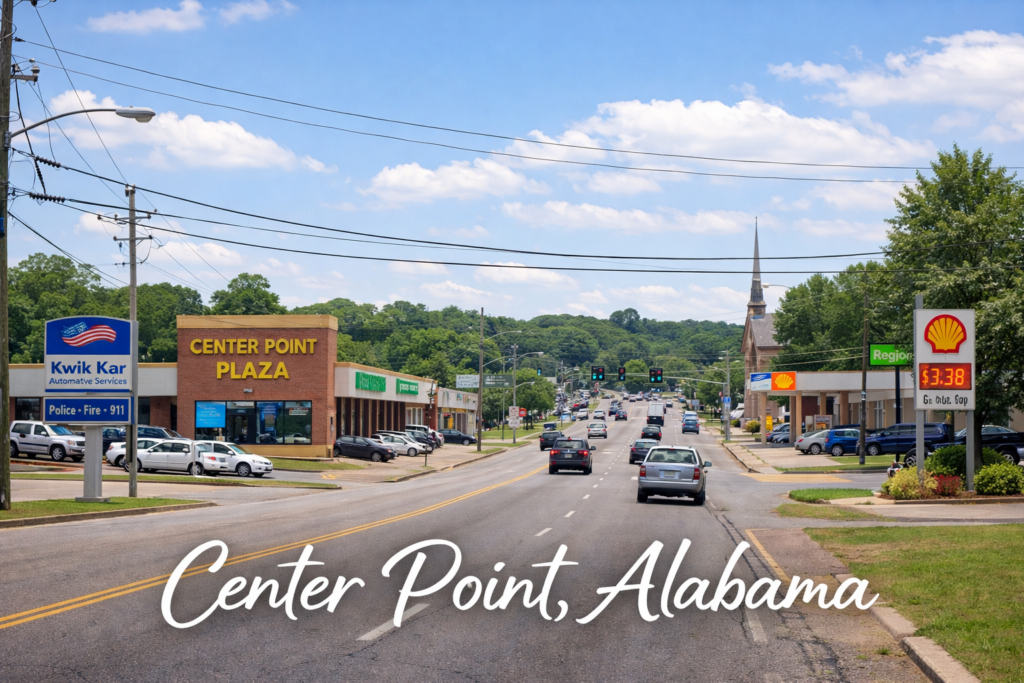
Property Management in Center Point, Alabama
Key Takeaways
- Lease Birmingham LLC provides residential, multi-family, and Section 8 property management in Center Point, Alabama.
- The content centers on Center Point’s local identity, naming Reed-Harvey Park, the Reed Harvey Community Greenway Wetland Park, Five Mile Creek, and Center Point Parkway as part of the city’s living context.
- The page highlights leasing, rent collection, maintenance coordination, inspections, documentation, and compliance as the practical work that protects owners from vacancy, failed inspections, delayed approvals, and preventable repair costs.
Center Point does not feel like a place that was tossed together in a hurry; it feels like a place that kept getting back up, a place that learned early how to stand in bad weather and then kept that lesson in its bones. The city’s own history reaches back to the Reed family in 1816, to a settlement that had grit before it had ease, and to a hard-won turning point in 1957 when a reliable water supply opened the door for real growth. By March 28, 2002, Center Point had made the choice to govern itself as a city, which is the kind of move a place makes when it is tired of being spoken for and ready to keep its own books.
There is a living, breathing stretch of local character here that no generic suburb copywriter could fake; it runs through Reed-Harvey Park, where the lake, boardwalk, amphitheater, and Veteran’s Memorial give the land a public heart, and it keeps moving through the Reed Harvey Community Greenway Wetland Park, where Five Mile Creek slides along with the calm of a thing older than every lease and louder than no one. Center Point still tends to itself in public view; the city highlights revitalization work, landscaping, creekbed restoration, and even a “Fight the Blight” campaign that makes plain what local people already know, which is that a neighborhood is not held together by slogans but by upkeep, attention, and a refusal to let neglect become normal.
That is why Property Management in Center Point is not some sterile business phrase that sits in a spreadsheet and minds its own business; it is street-level work, patience-heavy work, reputation work. A rental house on a quiet block is not just lumber and shingles. An apartment building is not just doors arranged in rows. Each property enters the life of the city whether the owner means for it to or not; each one either adds calm to the block or drags trouble in behind it like cans tied to a bumper.
The owner who tries to do it all alone soon learns what the heavy chains really are in modern Alabama; they are not forged iron, they are scattered invoices, late-night texts, leaking water heaters, skipped rent, patch jobs disguised as repairs, half-read ordinances, one contractor promising Tuesday and arriving never, one resident who says the lock is sticking, another who says the upstairs unit sounds like thunder at 2 a.m., and a ledger so cluttered it starts to look less like a record and more like a cry for help. The phantom of maintenance never waits for a good hour. It appears on weekends, on holidays, in the hour after dinner, and in the thin part of the night when a burst line can turn one small delay into a month of regret.
In Center Point, the fog of legalities is not imaginary. The city’s Code Enforcement office deals with trash, high grass, overgrown lots, illegal dumping, graffiti, non-running vehicles, and vacant or dilapidated structures. Inspection Services makes the local reality even plainer: no permit means no inspection for major trades, inspections are scheduled 24 hours ahead on a first-come basis, stop-work orders can be issued for noncompliant jobs, and rejected or missed inspections can trigger re-inspection fees. Lease Birmingham’s analysis of Center Point makes the same point from the landlord’s side; readiness, documentation, repair sequencing, and inspection timing decide whether a vacancy closes cleanly or lingers like a bad smell in the books.
Residential Property Management in Center Point
Single-family homes carry a private kind of dignity. They sit with their porches, driveways, fences, shrubs, mailboxes, school runs, grocery bags, and evening lights; they hold the rhythm of ordinary life, which is to say the most important rhythm there is. A house rented carelessly can unsettle a whole street. A house managed with steadiness can make the block breathe easier. This is where Lease Birmingham earns trust the old-fashioned way; not with polished talk, but with the daily, unglamorous discipline that keeps a home occupied by qualified residents, maintained before small issues turn expensive, and documented so the owner is not left guessing where the money went or why the repair bill doubled.
Lease Birmingham handles the parts that wear owners thin: marketing, leasing, tenant screening, rent collection, maintenance coordination, inspections, compliance oversight, and financial reporting. That matters in Center Point because a good rental home cannot be run on hope and a phone charger. It needs a system; it needs follow-through; it needs someone to notice that the dripping line under the sink is not just a drip, that the loose handrail is not just a handrail, that the resident who pays on time and gets treated fairly is more likely to stay and more likely to care for the place. Lease Birmingham steps into that space with the kind of order that turns ownership back into an asset instead of a running emergency.
There is also a moral side to residential property management that too many owners ignore until the property starts bleeding money. A home should feel solid when a resident shuts the door at night. The heat should work; the plumbing should behave; the lock should catch; the maintenance request should not disappear into the digital void like a prayer sent to the wrong address. Lease Birmingham protects the sanctity of the single-family rental by treating upkeep as protection, not as a nuisance line item. That is how value is preserved in real life; one screened resident, one documented repair, one avoided vacancy, one steady month at a time.
Multi-Family Property Management in Center Point
Then there are the great hives of modern life; the duplexes, four-plexes, courtyard buildings, apartment communities, and every clustered arrangement where one person’s noise becomes another person’s headache, where one clogged drain can wander down a wall and become everybody’s problem, where shared parking, shared trash areas, shared hallways, and shared expectations can either produce order or wear everybody raw. Multi-family property is where weak management gets exposed fast. The building starts talking back. Turnover rises. Complaints stack up. Small disputes get mean. Deferred maintenance turns common areas tired and then shabby; shabby turns to mistrust; mistrust turns to vacancies.
Lease Birmingham brings the firm hand that these properties need, not a harsh hand, not a careless hand, but a steady one. Lease Birmingham’s multi-family property management work centers on tenant placement, retention, maintenance handling, financial oversight, inspections, and community relations. That means the property is not left to drift into chaos while the owner tries to put out fires by text message. Units are filled with purpose; common areas are kept from slipping; rent collection is handled with consistency; problems are addressed before residents decide the building is not worth staying in. In a city like Center Point, where people notice when a place is cared for and notice even faster when it is not, that difference can be the whole story of whether a property builds value or sheds it.
Good multi-family management is half maintenance, half human judgment, and every bit of it matters. One resident wants quiet. Another wants speed. Another wants fairness. All three are reasonable, and all three become impossible to satisfy when the owner is improvising. Lease Birmingham keeps harmony among many neighbors by placing structure where confusion likes to spread; clear communication, routine oversight, prompt repair routing, and records that do not vanish when someone changes phones. A multi-family property in Center Point should not feel like a building no one is steering. It should feel lived in, respected, and under watch in the best sense of the phrase.
Section 8 Housing in Center Point
Section 8 Housing in Center Point is serious work because housing is serious work. There is nothing flimsy about it, nothing ornamental about it, nothing that should be treated like a lesser branch of the rental business. These homes shelter working families, grandparents raising grandchildren, people piecing together long shifts and short budgets, people who need a place that is safe without being out of reach. The noble thing here is not sentiment; the noble thing is competence. A roof that does not leak. Utilities that function. A stove that works. A door that locks the way it should. A unit that meets the standard because the standard exists for a reason.
On the federal side, the Housing Choice Voucher process is exact. HUD’s Request for Tenancy Approval starts the move-in approval process, and the public housing agency cannot approve the tenancy or execute the housing assistance contract until the unit is eligible, the rent is reasonable, the lease is properly executed, and the property passes Housing Quality Standards inspection. Those are not little details tucked in the margins; those are the gatekeepers between vacancy and payment, between a promised move-in and a real one.
This is why Section 8 Housing in Center Point needs management that respects both the resident and the paperwork. Lease Birmingham’s affordable housing and Section 8 property management is built around tenant eligibility verification, inspection coordination, rent collection, maintenance handling, and compliance tracking. Lease Birmingham’s own Center Point writing leans hard into readiness files, inspection timing, maintenance triage, and documentation control because voucher leasing does not reward sloppy habits; it punishes them with delays, failed approvals, and unit downtime. For owners who want to provide solid housing without getting buried under forms, dates, follow-up visits, and preventable mistakes, Lease Birmingham brings the calm that keeps the process moving.
There is a certain cheap cynicism that sometimes hangs around affordable housing, and it deserves to be thrown out with the broken blinds and water-damaged drywall. The truth is much plainer and much better; decent Section 8 management helps stabilize streets, helps preserve units that might otherwise slide into disrepair, and helps keep Center Point’s sturdy citizens under roofs that honor basic human dignity. In a city publicly working against blight and putting visible effort into upkeep and revitalization, properly managed affordable housing is not apart from the civic story; it is part of the civic story.
The Steady Hand Behind the Work
Lease Birmingham should be understood in Center Point the way a wise owner understands a reliable set of keys; not flashy, not theatrical, just always where the key turning needs to happen. Lease Birmingham serves Center Point as part of a broader Jefferson County footprint and presents a property management approach built on local market knowledge, full-service operations, and a stated commitment to trust, transparency, and professionalism. That combination matters because the owner’s real need is not noise. The owner’s real need is to sleep through the night without wondering whether tomorrow will bring unpaid rent, a missed inspection, a bad resident fit, or a repair that doubled because no one handled the first call properly.
Call Lease Birmingham a benevolent steward if that fits the mood; call Lease Birmingham a faithful clerk if that better suits the ledger; call Lease Birmingham the steady hand behind the curtain if plain speech is preferred. The point holds. Lease Birmingham watches the owner’s interest while the owner is at work, at dinner, on the road, or asleep. Lease Birmingham stands between the property and the little disasters that love neglected rentals. Lease Birmingham keeps the calendar, the maintenance chain, the resident communication, the leasing process, the reporting, and the compliance burden from scattering into ten different directions. In Property Management in Center Point, that kind of steadiness is not a luxury. That is the work.
A Strong Invitation to Act
Center Point is not a city that rewards drift. It rewards attention. It rewards upkeep. It rewards the owner who understands that a rental property is part of a neighborhood before it is part of a balance sheet. The streets around Center Point Parkway, the green edge of Five Mile Creek, the public life around Reed-Harvey Park, the steady fight against blight and neglect; all of it says the same thing in different languages. Care matters here. Disorder costs.
So let the ledgers be cleared; let the midnight repair panic be somebody else’s burden; let the phantom of maintenance lose its favorite number; let the fog of legalities lift. Hire Lease Birmingham for Property Management in Center Point and put the property in the hands of a company built to protect income, reduce vacancy, keep residents supported, and keep the asset standing straight. For owners with residential rentals, multi-family properties, or Section 8 Housing in Center Point, the invitation is plain: contact Lease Birmingham, schedule the conversation, and hand the work to a manager worthy of the city.