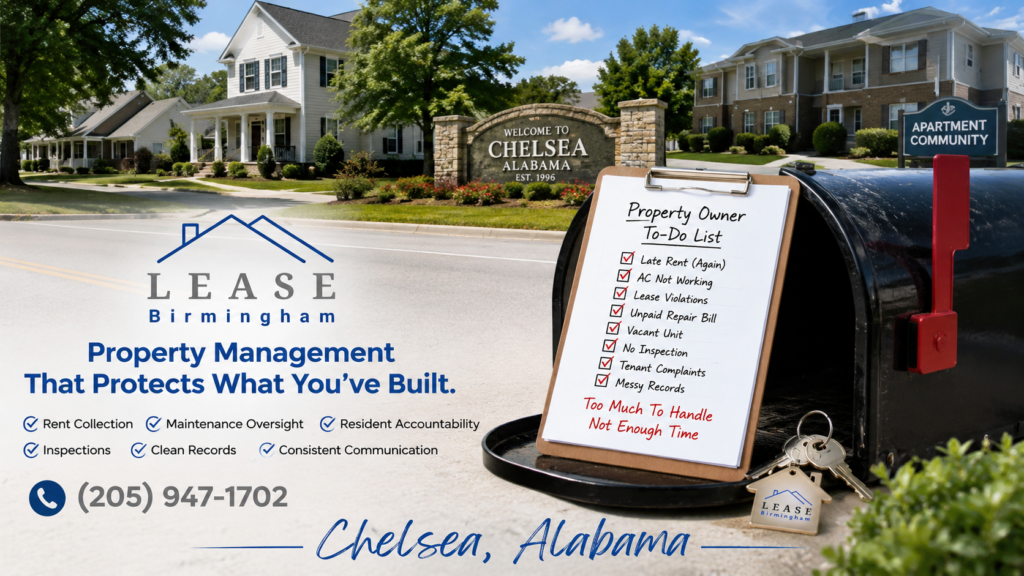
Property Management in Chelsea, Alabama
Key Takeaways
- Chelsea rentals can look calm from the road while the real loss starts behind the door: late rent, stale vacancy, weak tenant placement, sloppy records, and repair bills that no one questioned before the money left.
- The Chelsea setting matters because the page ties rental risk to a real place: Highway 280 pressure, the old Melrose history, Chelsea City Hall, Chelsea Historical Museum, Double Oak Park, and Chelsea Community Center all frame a city where growth does not make ownership easier.
- Single-family homes, multi-family buildings, and Section 8 rentals each fail in different ways when the wrong person is watching them. Lease Birmingham LLC is positioned as the property management company that keeps rent, repairs, resident conduct, records, and owner communication from becoming another job dumped back on the owner.
Road Heat Over Old Shelby County Ground
A rental house in this part of Shelby County does not sit inside a soft sketch of country life. It stands where Highway 280 carries work trucks, school traffic, grocery runs, church mornings, youth sports, repair crews, new residents, old families, contractors, commuters, and every ordinary pressure that makes a growing Alabama city feel alive before sunrise. The old Melrose name still belongs to the deeper local story, while the Chelsea name carries the sound of railroad movement, road growth, new roofs, settled routines, and plain ambition on ground that still remembers a quieter time.
No owner should look at that surface and call it simple. A clean street can still hold a neglected rental. A trimmed yard can still hide weak oversight. A polite tenant can still become a rent problem when the standard bends. A newer roofline can still cover poor repair history. A house that looks calm from the road can still be working against the owner through late rent, bad documentation, missed inspections, careless vendor choices, and soft decisions that gather strength behind the front door.
Public life gives the city shape. Local government gathers at Chelsea City Hall. Older memory stays visible at Chelsea Historical Museum. Family noise and weekend movement fill Double Oak Park. Daily local rhythm moves through Chelsea Community Center in the plain pattern of meetings, activities, and neighbors crossing paths. These places give the city real life instead of empty subdivision noise.
The better owner reads warnings before they become invoices. After enough late calls and surprise repairs many owners learn that Property Management in Chelsea is a cost control decision before it is a convenience. The point is not to dress the work in pleasant language. The point is to keep rent moving, keep records clean, keep repairs honest, and keep the property from training everyone around it to expect weakness.
The toil of the streets does not arrive with theater. It arrives through grass that grows, gutters that clog, rent that comes due, water that finds weak places, vendors who miss appointments, residents who test boundaries, and vacant houses that begin to feel stale behind closed blinds. The triumph comes only when the owner refuses to confuse calm with control.
The Private Owner Facing The Ledger Alone
A private landlord often begins with confidence because the property has not yet been tested. The lease is signed. The resident sounds reasonable. The house photographs well. The rent amount looks clean on paper. For a short season, ownership can look like a simple exchange of keys followed by monthly deposits.
Then daily life moves into the property. Water appears under a sink after the owner has already finished a long day. A payment does not arrive when promised. A neighbor sees trouble before the owner does. A vendor gives a price that explains little. A resident asks for more time again. The owner who expected income now has to become clerk, inspector, bill reviewer, collector, rule keeper, repair judge, and witness.
That is the real weight of managing alone. It rarely arrives in one grand crash. It tightens through small decisions that look harmless in the moment. A late payment receives softness instead of structure. A cheap repair is approved because the proper correction feels unpleasant. A lease term is ignored because enforcement feels tiring. A tenant message is treated like documentation because proper records take effort. The chain forms one link at a time.
A cluttered ledger eventually tells the truth. It shows every charge that was never questioned, every pattern that was not stopped, every repair that was not verified, every resident story that was accepted too quickly, and every soft decision that invited the next soft decision to walk in and sit down. The numbers do not merely show expenses. They show judgment.
Maintenance waits until the owner is least ready to deal with it. Water stains do not care that the month is busy. HVAC failure does not care that the owner is out of state. A worn roof edge does not care that the rent looked strong last quarter. Cheap repairs often dress themselves up as savings, but the property knows the difference between a real correction and a temporary disguise.
Legal trouble brings another weight. Notices need accuracy. Lease enforcement needs consistency. Security deposit decisions need records. Access to the property needs proper handling. Resident communication needs fairness and force. Informality feels easy until a dispute arrives and asks for proof. The file must be able to speak when the owner is not in the room.
Single Family Homes Require More Than Rent Collection
A single-family rental looks harmless when the grass is cut and the porch light works. The front door closes. The driveway looks normal. The rooms seem quiet enough to calm a distant owner. Houses are skilled actors when the first signs of neglect have not yet become visible.
The real condition lives deeper than the curb. The real question has already become sharper by the time an owner compares Residential Property Management in Chelsea because the house has started asking who will protect it when money is at stake. A strong process watches the lease file, the payment record, the inspection pattern, the maintenance history, the resident tone, and the vendor response before those pieces become a larger loss.
A resident deserves a safe and functional home. An owner deserves a property that is not surrendered to excuses. Those duties belong together. They only fight each other when the property manager has no spine. Clear expectations protect residents from confusion and protect owners from avoidable loss.
Tenant placement is the first guard at the door. Vacancy creates pressure, and pressure is a dangerous counselor for anyone holding a rental house. The wrong resident does not merely occupy rooms. The wrong resident teaches the property new costs through late rent, rough use, ignored yard care, unauthorized occupants, vague complaints, and behavior that grows bolder every time the owner hesitates.
Repair judgment is the second guard. A good property manager does not approve a repair just because the request sounds urgent. A good property manager does not deny a repair just because the owner would rather avoid the cost. The cause has to be found. The vendor has to be questioned. The work has to protect the property instead of decorating the symptom.
Inspections matter because houses suffer quietly. A dripping valve, soft flooring, stained ceiling, damaged door frame, broken blind, loose rail, neglected yard, or torn screen can point to a larger problem. Waiting for the resident to report every issue is not property management. It is surrender with a nicer shirt.
A single-family home carries daily life inside its walls and serious capital beneath its roof. That arrangement deserves steady eyes, direct communication, clear enforcement, and repair decisions made by someone who understands how quickly a small problem becomes the next drain on the owner ledger.
Many Doors Make Weak Property Management Costly
A building with multiple units has a different voice. One resident problem can disturb another resident. One slow repair can travel through several walls. One weak rule can teach a whole hallway that the standard has no teeth. One empty unit can sit too long while income leaks out of the month without making noise.
Many doors create many chances for disorder to take root. A building with several tenants has already made the question more serious by the time an owner needs Multi Family Property Management in Chelsea because the pressure comes from several directions at once. Rent collection, move-in control, maintenance coordination, resident communication, parking discipline, common-area condition, and vacancy handling all have to work together or the property begins to lose command of itself.
Apartment living and small multi-unit rental property depend on rhythm. Residents need to know what is expected. Owners need to know what is happening. Vendors need direction. Records need order. Complaints need a response that is fair without becoming weak. Rules need to mean the same thing on Monday that they meant the week before.
A loose property manager lets every small issue become public instruction. When one resident pays late without consequence, others learn. When trash rules are ignored, the building learns. When noise complaints bring no action, patience leaves the property before the tenant does. When repairs move slowly, confidence drains out of the building. The owner pays for all of it.
Multi-unit property management requires more than friendly emails and invoice forwarding. It requires a person willing to hold the line when convenience wants to step over it. The manager has to see the building as a living system where one weak decision can move from door to door. The duty is not to keep everyone pleased in the moment. The duty is to keep the property stable.
Harmony inside shared rental space is not created by good wishes. It is created by clean records, timely action, steady rules, resident screening, repair follow-through, and a property management standard that treats disorder as a cost before it becomes a culture.
Section 8 Housing Requires Order With Respect
Affordable housing carries a serious duty. A resident with assistance is still a resident who needs a clean process, working systems, safe conditions, and a door that closes without doubt at the end of the day. An owner who accepts that process still needs rent tracking, inspection readiness, repair control, documentation, and firm resident expectations. Compassion does not replace structure. Structure is what keeps compassion from becoming chaos.
The work has to be handled with direct care. The paperwork and repair obligations carry more weight for owners who rely on Section 8 Property Management in Chelsea because the process demands structure that respects residents while protecting the property. That means the manager has to understand paperwork, inspection concerns, resident obligations, owner obligations, rent portions, repair timing, and the need for records that can stand up when questions arrive.
No resident should be treated as a lesser person because part of the rent comes through a program. No owner should be expected to accept weak property care because the arrangement has paperwork attached. A good house is still a good house. A leaking roof is still a leaking roof. A broken lock is still a broken lock. A missed obligation is still a missed obligation.
Section 8 rental property is damaged by two kinds of failure. One failure is neglect that treats residents as if they should accept less. The other failure is softness that treats the owner asset as if standards no longer matter. Both are wrong. Both cost money. Both create the kind of property trouble that spreads beyond one house.
The better path is plain. Handle the resident with respect. Handle the file with order. Handle the repairs with judgment. Handle the owner interest with strength. Affordable housing does not ask for weaker property management. It asks for clearer property management because the process has more parts and every part has to be held properly.
A sturdy resident deserves a roof that holds and a door that locks. A serious owner deserves a property that is not ruined by poor process. Those two truths can stand together when the person managing the rental has enough discipline to protect both.
The Watchman Standard At Lease Birmingham
A rental property needs more than a polite name on a monthly statement. It needs a watchman. It needs someone who sees patterns before they become losses, questions invoices before they become habits, reads resident behavior before it becomes damage, and treats the property as capital rather than an address with a rent amount attached.
Rent collection is not a side task. Repair judgment is not paperwork. Resident conduct, lease enforcement, records, and owner communication are the bones of the rental business, and when one bone breaks the whole property starts limping toward loss. A rental owner who calls Lease Birmingham is not asking for a softer voice on the phone or a prettier report at the end of the month. The owner is asking for the rent to be collected, the file to hold up, the resident to be held to the lease, and the property to be defended from every lazy repair, weak excuse, and quiet leak that wants a piece of the ledger.
This is not corporate fluff dressed up for an owner who already knows better. A property owner does not need cheerful language while money slips out through vacancy, weak tenant placement, careless maintenance, and poor communication. The owner needs a property management company that tells the truth early and acts before the situation becomes more difficult to control.
The work at Lease Birmingham is to serve as the steady keeper of owner interest. The company does not exist to make disorder sound acceptable. The work is to keep the asset in view, keep the process clean, and keep the owner from carrying every call, every invoice, every resident excuse, and every legal shadow alone.
Out-of-state owners need that even more. Distance makes weak property management expensive. A house can change condition while the owner is sleeping in another state. A resident can stop caring. A vendor can miss the real issue. A vacancy can sit too long. A neighbor can know the property is in trouble before the owner hears a word. Distance does not create the problem, but it gives the problem room to grow.
Serious owners do not buy rental property so they can spend evenings sorting through excuses. They buy property to hold an asset, collect income, protect capital, and build a cleaner financial future. That only works when the property is managed with discipline sharp enough to stop small problems from becoming the house language.
Put The Rental Where Discipline Holds
A Chelsea rental will not become easier because the owner waits. The late payment will not become stronger because the owner hopes. The bad repair will not become cheaper because the owner avoids the proper answer. The careless resident will not become more careful because the rules remain soft. The vacant house will not become profitable because the owner dislikes pressure.
Delay is a manager too. It manages the property badly. It lets small repairs grow. It lets resident habits settle. It lets invoices blur. It lets the owner mistake silence for health. It lets the rental write its own rules with the owner’s money.
A better choice is available before the property has to shout. Place the Chelsea rental with Lease Birmingham and put a disciplined property management company between the asset and the small failures that want to eat it piece by piece. Let the rent be pursued by a process instead of mood. Let repairs be judged by need instead of panic. Let residents receive fair treatment without permission to weaken the lease. Let the owner receive clear communication instead of scattered noise.
Peace of mind does not come from pretending the work is light. It comes from putting the work in hands that respect how heavy it really is. A rental property is too valuable to be left to hope, softness, scattered records, and last-minute decisions. It needs judgment at the door before trouble gets comfortable on the porch.