The New Suburban Math: Turning Your Backyard Into A Second Revenue Stream In Gardendale, Alabama
Key Takeaways
- Oversized backyards in Gardendale can carry more financial value as separate residential assets than as unused lawn, especially in a market where buildable land inside established neighborhoods has grown more important.
- A rear lot split can open several paths, including a smaller detached rental house, a parcel sale that strengthens the main property, or a reserved build site held for better timing.
- Not every deep yard is a viable second parcel, because access, lot shape, utility reach, drainage, and practical build area decide whether the land can support another dwelling.
- Smaller infill housing matters in Gardendale because it can create a more attainable detached-house option for renters who want neighborhood access without the cost burden of a larger suburban footprint.
- Two residential assets on one original lot demand disciplined oversight, because separate bills, service coordination, maintenance schedules, records, and occupancy planning can quickly erode the return when handled carelessly.
Introduction
The Backyard That Sits Quiet While Costs Keep Moving
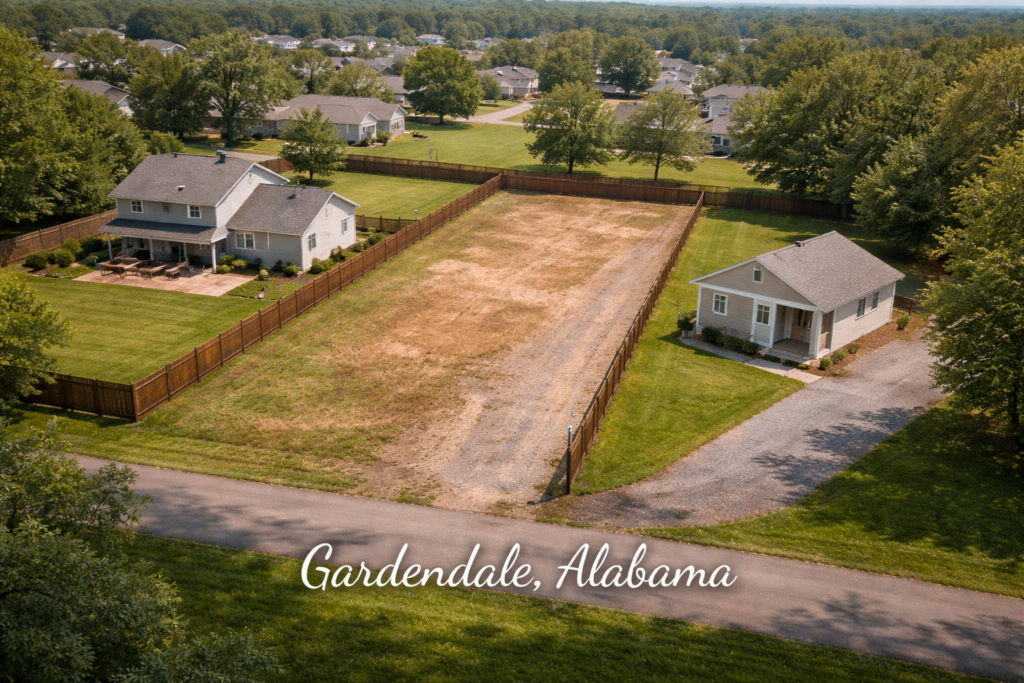
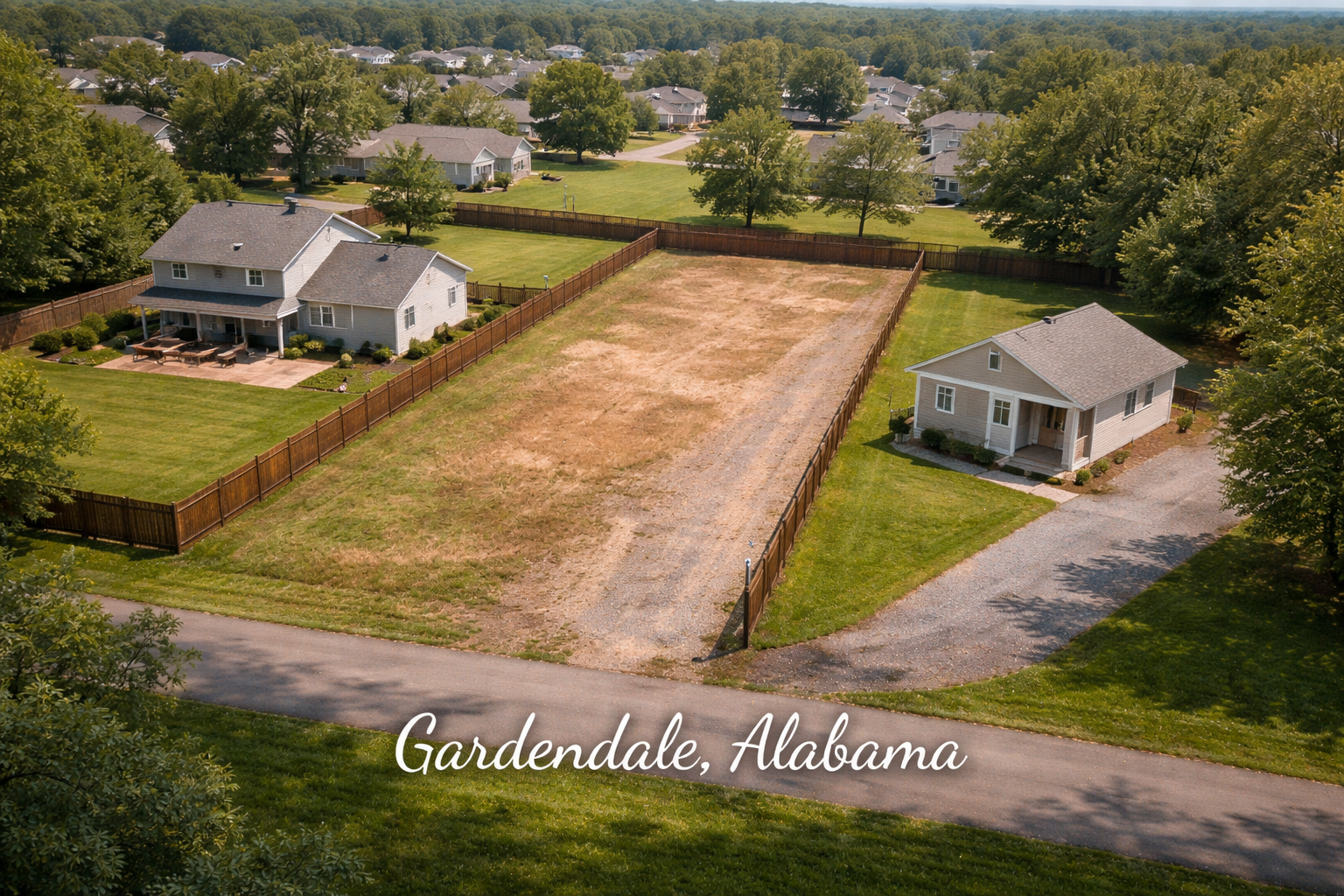
A deep backyard in a suburban setting often lives under an old assumption. The house earns its keep, while the ground behind it merely frames the scene and asks to be maintained. That habit of thought made sense when land was cheap, supply felt abundant, and a broad yard signaled comfort more than unrealized value. In a tighter market, the rear portion of a lot begins to look less like decoration and more like dormant acreage tied to taxes, mowing, drainage concerns, fence upkeep, storm cleanup, and the plain expense of holding land that does not produce income.
That change in perspective begins with the arithmetic of ownership rather than romance about open grass. A parcel is not only a setting for the structure on the street. A parcel is depth, frontage, access, grade, utility reach, and the physical possibility of carrying more than one use over time. When the front house has already reached a practical rent ceiling, the owner’s attention often turns toward the land itself because the structure alone cannot always carry the next increase in value. The central question is not whether a backyard feels pleasant or familiar. The central question is whether the rear ground can become a second stream of value through a lawful split, a future build site, or a saleable piece of residential land.
Gardendale has reached the sort of moment that makes this question impossible to dismiss as idle speculation. Zillow’s rental market page for Gardendale showed an average rent of $1,933 as of March 18, 2026, a year-over-year increase of $436, with only 17 rentals listed at that snapshot, which is the kind of pressure that forces attention toward land already sitting inside established neighborhoods rather than toward endless new supply at the far edge of the map. In that climate, the backyard stops being merely a private patch of green and becomes part of the property’s economic story. The rear yard may still remain a yard, yet it can no longer be treated as though it has no financial identity of its own.
Why Owners Are Looking Past The House And Toward The Land
Owners are looking past the house and toward the land because the local housing conversation has grown more urgent, more practical, and less patient with wasted space. Gardendale is not dealing with a small matter of taste or architectural fashion. It is dealing with the broad question of where future housing will come from, what forms it can take, and how existing neighborhoods can absorb growth without waiting for distant tracts to solve every shortage. When a market presses upward and supply does not keep pace, every large residential lot begins to invite a second look. The ground behind the original structure becomes part of that inquiry because it may hold one of the few realistic openings for small-scale infill inside a built community.
That pressure is visible in the city’s housing work. Gardendale’s Housing Needs Assessment projects 7,552 households by 2035 and estimates that about 1,200 additional housing units will be needed over the next decade, while also pointing toward a broader mix that includes townhomes, small apartments, senior-oriented housing, and infill duplexes rather than relying on one housing pattern alone. Those facts matter because they shift the subject away from a private backyard fantasy and into a community-level issue shaped by demand, land use, and the need for more varied residential options. A deep lot behind a single house is still private property, yet it also sits inside a wider housing environment where buildable land has become more precious and more contested.
That is why the rear portion of a lot now carries so much interest from owners, investors, and residents. A backyard can become a second parcel with its own development path, a site for a smaller detached house, or a source of sale proceeds that strengthen the main property without erasing the original home from the lot. The subject deserves a close and factual examination because the difference between a handsome yard and a viable second revenue stream lies in details such as site layout, access, utilities, frontage, cost, and management discipline. Once those facts enter the room, the old suburban picture changes. The house remains important, though the land behind it begins to stand as an asset in its own right rather than as silent ground waiting to be cut again next Saturday.
Why The Backyard Has Entered The Revenue Conversation
The Cost Of Holding Land That Produces Nothing
A deep backyard does not sit on the books as an innocent stretch of green. In Gardendale, that rear ground often asks for steady mowing across a broad span that may never be used in proportion to its size. Fence lines sag, brush creeps inward, limbs fall after storms, and any corner left unattended soon becomes a place where debris, neglected materials, or overgrowth gather without invitation. Where slopes, tree cover, or drainage features are present, the owner may also face repeated cleanup and grading concerns that add labor and expense without producing a dollar of income.
That is the burden of land that behaves like an expense while being treated like an amenity. The front house earns rent or supports occupancy, yet the rear portion of the lot may do nothing beyond framing the structure and enlarging the mowing route. In a market where every repair invoice arrives with less mercy than the one before it, unused land starts to look less like comfort and more like underperforming square footage. Dead acreage is not worthless acreage. Dead acreage is land that carries paper value, absorbs maintenance, and contributes no cash flow in its present form.
The local land market makes the point more clearly than sentiment ever could, because buildable residential ground in Gardendale is already being offered and priced on its own terms rather than treated as leftover yard attached to another structure. Movoto’s March 2026 Gardendale land page showed 28 land listings, with smaller lots under an acre offered across a wide price range, one-acre parcels nearing the upper end of that smaller-lot range, and larger tracts climbing far beyond that level, which shows that size, frontage, and development potential are already being translated into asking prices in plain public view. For the owner with an oversized rear lot, that fact matters because the market is signaling that residential land has value apart from the existing house, even before any new structure is built on it. Once that reality is acknowledged, the backyard stops looking like free visual space and starts to resemble idle capital that is being cut, maintained, and carried year after year without producing income.
The Shift From Yard Space To Parcel Value
The conversation changes when local planning and market economics stop rewarding land solely for its openness and start rewarding it for its yield per acre. Gardendale’s 2025 Housing Needs Assessment says changing demographics are driving demand for alternatives to the traditional single-family option and states that denser housing, from smaller single-family lots to townhomes, apartments, and condos, produces a higher tax base per acre. That sentence carries more force than a slogan because it turns the backyard into a measurable part of the property rather than a sentimental afterthought. Rear lot depth begins to matter not only for privacy, but for what it may support in a market that needs more housing forms and more productive use of buildable land.
That is why owners have started to look at the back half of a lot through the lens of parcel creation, build potential, and sale potential. A yard once judged by grass coverage and shade trees is now judged by access, dimensions, utility reach, slope, and the practical chance that the land could stand on its own as a second residential site. The question is no longer confined to whether the existing house looks attractive with a large yard behind it. The question becomes whether that same ground can carry a second identity and a second financial purpose without swallowing the value of the original structure.
Parcel value changes the tone of the entire discussion because it pulls the owner out of habit and into analysis. A rear yard measured only as leisure space tends to be defended by memory, routine, and the old suburban picture of what a lot ought to look like. A rear yard measured as a potential parcel is judged by return, flexibility, and timing. In Gardendale, that shift matters because a backyard may now represent sale proceeds, a future build site, or a reserve asset that can be activated later, which is a far more serious role than simply serving as a patch of land that must be cut again next week.
The Gardendale Conditions That Make Backyard Infill A Real Topic
Housing Demand And The Search For New Supply
Pressure in Gardendale is no longer confined to the ordinary complaints of a busy housing market. The matter has moved into the structure of the market itself, where buyers, renters, and owners are all confronting the same plain difficulty from different sides of the fence: desirable housing in established neighborhoods does not multiply on its own. When supply remains narrow, every existing lot begins to carry more weight, because the shortage is not merely about how many roofs exist today but about how few practical places remain to add the next ones. That is why the backyard conversation has grown serious. It is not driven by novelty. It is driven by scarcity, by price pressure, and by the growing realization that the next unit of housing may have to come from land already sitting behind an existing house.
The for-sale market shows why this subject has moved from speculation into hard local relevance. Redfin reported that the median sale price in Gardendale reached $322,450 in February 2026, up 46.6 percent from a year earlier, while 24 homes sold that month and the average home took 56 days to sell. Those figures do not suggest a place with abundant cheap options waiting quietly on the sidelines. They suggest a market where the cost of entering, moving up, or adding to a portfolio has become more demanding, which makes smaller infill opportunities look more practical than they once did. A modest detached house on a newly created rear parcel attracts attention in that setting because it can place a new dwelling into an existing neighborhood without requiring the purchase of a large new tract or the construction of another full-sized suburban footprint.
Smaller new housing draws interest in Gardendale for another reason that is less dramatic, though no less important. Many households do not need a sprawling floor plan, a massive yard, or the cost burden that often travels with both. They need a clean, functional, well-placed house in a community they already want to enter, and that makes a smaller infill dwelling feel less like a compromise and more like a rational answer to a market that has grown expensive at the larger end. Owners notice that shift because the rear portion of a deep lot can sometimes answer demand that the front house cannot. Investors notice it because a compact infill residence may fit local budget realities more neatly than a larger new build. Residents notice it because the search for housing grows sharper when the standard suburban product keeps drifting farther out of reach.
Why Existing Lots Matter More Than Empty Tracts
Already-served residential lots draw interest because they begin the story with advantages that raw outlying land does not possess. Streets are already there, neighborhoods already exist, and the market has already proven that people want to live in those locations. A deep lot inside an established part of Gardendale is not trying to invent a place from scratch. It is working within a place that already has identity, traffic patterns, service expectations, and a visible record of residential demand. That matters because the question is not only whether more housing can be built somewhere. The question is where new housing can be added in a way that is physically practical, economically sensible, and tied to the daily life of the city as it already functions.
County subdivision guidance makes the practical appeal of such lots even clearer, because a minor subdivision is defined as one that fronts on an existing street and does not involve the extension of utilities or the creation of public improvements. That distinction explains why existing lots matter so much more than distant greenfield acreage when owners begin thinking about infill. Land at the edge of development may offer size, though it often brings a heavier burden of cost, coordination, and time. A deep backyard lot inside an already-settled area enters the conversation with a shorter route between idea and feasibility because it begins with a built context instead of an empty one.
The broader housing conversation in Gardendale turns on that difference. Deep suburban lots have become relevant because they allow new housing to emerge from land that has long been absorbed into the city’s ordinary pattern of streets and houses, rather than waiting for a far-flung tract to be opened and sold in full. That is why the backyard matters more than it once did. It offers the possibility of adding one dwelling, one parcel, or one saleable piece of residential ground without asking the city to chase growth endlessly outward. Infill on existing lots is receiving attention because it treats the land inside the community as part of the answer, not because the old suburban yard has suddenly become unfashionable, but because the mathematics of supply have made idle space far harder to defend.
The Lot-Split Math Behind A Second Revenue Stream
What A New Legal Parcel Can Change
A rear parcel changes the financial picture because it stops being judged only as the leftover ground behind the main house. While it remains part of one undivided lot, its value is trapped inside the broader impression of the property, mixed together with the front structure, the yard, the driveway, the fence lines, and every other feature that makes the place feel like one home with one footprint. Once that rear portion becomes a separate parcel, the land begins to stand in public view as something more exact. It can be evaluated on its own dimensions, its own access, its own building potential, and its own place in the market rather than as a patch of grass that happens to lie behind a roof already in service.
That separation matters long before a foundation is poured. A lawful rear parcel can open a distinct path for sale, for future construction, or for long-term holding, and each path carries a different financial meaning for the owner. Sale proceeds may be used to retire debt, fund repairs on the main house, improve reserves, or support another acquisition. A future build site may be held until construction costs, financing conditions, or household timing become more favorable. Even when no immediate construction begins, the owner is no longer holding only a house with an oversized yard. The owner is holding a house and a second residential asset with its own possible future.
The practical force of that change lies in the city’s own subdivision framework, which defines a lot split as the subdivision of a previously recorded lot into two lots on an existing street and defines a minor subdivision as one that creates not more than five lots fronting on an existing street without new streets, public-facility extensions, or public improvements. That language matters because it turns the backyard from incidental land into a parcel category the market can recognize and price. A new address does not create value by ceremony alone. It creates value because separation alters how the rear ground can be titled, marketed, financed, transferred, or developed, which changes the economics of the property even before a single wall rises from the dirt.
Measuring Cost Against Potential Gain
The cost side of the equation arrives first and rarely arrives in a single neat invoice. Before a rear yard can become a revenue-producing asset, the owner must usually account for surveying, plat preparation, site review, filing, and the practical work of confirming whether the land can function as a separate residential lot rather than merely look large from the back porch. Utility reach, driveway layout, drainage conditions, grade, and the geometry of the lot all matter because a split that looks simple from the fence line can turn costly when the paper trail meets the physical site. That is why the real math begins before anyone speaks about rent. The first question is not how much a second house might earn. The first question is how much must be spent to turn backyard ground into a parcel that can stand on its own.
Potential gain, by contrast, is created by separation itself. The moment the rear ground becomes a lawful buildable parcel, the owner has moved from holding unused land to holding a second asset with options attached to it. That second asset may be sold as a standalone lot, kept for later construction, or used as the site for a smaller detached house that adds income without sacrificing the front dwelling. The gain is not confined to one dramatic payday. In many cases, the gain lies in flexibility, because the owner can choose the timing of a sale, the timing of construction, or the timing of a longer hold based on market conditions and cash needs rather than being locked into the old all-or-nothing model of one lot serving one house forever.
The local land market explains why owners in Gardendale are willing to run that comparison with fresh seriousness, because Zillow’s land page for the city showed sub-acre lots listed from $10,000 to $64,000 at the March 2026 snapshot, which makes plain that even modest residential ground is already carrying standalone asking prices in the open market. That does not mean every backyard will justify a split, and it does not mean every split will produce a strong return. It does mean the potential value created by a lawful parcel is no longer theoretical. Owners are weighing survey and subdivision expenses against an asset that may be sold, built on, or held for future timing, and that is the sort of arithmetic that can change the meaning of the land behind the house.
What Makes A Backyard Parcel Viable
Access, Shape, And Utility Feasibility
A rear parcel begins with access, because land without a practical route to the street is not a second homesite so much as a stranded idea. The eye may be impressed by depth alone, though depth does not carry a car, a delivery truck, a utility crew, or an emergency vehicle to the place where a house would stand. The space between the existing house and the lot line must be judged with a colder sort of honesty than most backyards ever receive. A narrow strip of side yard may look passable on foot and still fail the moment one asks it to serve as the entrance to an entirely separate dwelling.
Shape carries the next burden. A rear parcel needs room not only for a building footprint, but for the ordinary workings of residential life: approach, clearance, service access, yard area, drainage paths, and a layout that does not leave the new dwelling squeezed into an afterthought of leftover geometry. Local subdivision regulations make that plain by stating that residential flag lots are only approved in low-density residential and agricultural areas, requiring the staff portion to remain at least 25 feet wide throughout its length and no longer than 300 feet unless the Fire Marshal approves otherwise. Those standards matter because a backyard can be large on paper and still fail if the route to the rear parcel is too narrow, too long, or too awkward to support a safe and workable pattern of access.
Utility feasibility is where many hopeful sketches lose their composure. A second parcel must be more than open ground behind a fence, because a residence cannot function on charm, optimism, or sheer lawn area. Water service, sewer service, drainage handling, meter locations, and the physical path of utility connections all shape whether a rear lot can operate as a real residential site rather than a speculative diagram. A backyard only becomes a second revenue-producing parcel when access, buildable shape, and service connections can stand together without one of them collapsing the whole arrangement.
The Difference Between Extra Land And Usable Land
Extra land and usable land are not the same thing, and the confusion between them has misled many owners who looked from the porch and mistook visual breadth for practical capacity. A backyard can seem immense when measured by mowing time, fence length, or the number of trees standing near the rear line. That same yard can feel much smaller once setbacks, driveway alignment, utility corridors, grading limits, and building placement are placed upon it like weights on a scale. The difference is not poetic. It is physical, measurable, and stubborn.
Usable land must hold a coherent residential plan. The site has to allow a dwelling that sits with dignity on the lot instead of appearing jammed into the rear by force of ambition. Room must exist for approach, parking, maintenance access, stormwater movement, and the basic separation that keeps two dwellings on one original tract from feeling like an error in judgment. A broad rear yard that pinches into an awkward corner, breaks sharply in elevation, or leaves only a cramped buildable pad may still be extra land, though it is not land that lends itself to a sensible second parcel. That distinction is where many backyard notions grow quiet, because the map and the ground do not always agree.
The city’s own regulations draw that line with blunt clarity by stating that land subject to flooding or deemed topographically unsuitable for development shall not be platted for residential occupancy or any use that may increase danger to health, life, or property, aggravate erosion, or increase flood hazard. That single rule explains why a large yard may fail even when its dimensions seem generous. Ground that carries drainage problems, unstable slopes, or other physical constraints may look promising from the rear deck and still be unfit for a practical residential plan. Viability is not created by square footage alone. Viability appears only when the land can support a second dwelling in a manner that is buildable, serviceable, and worth the cost of bringing it into lawful use.
Two Paths Owners Can Take After The Split
Holding The Rear Parcel For A Smaller House
One path after a successful split is to keep the rear parcel and place a smaller detached house upon it rather than treating the land as merchandise to be sold at once. That choice changes the old suburban logic of the lot. The front house remains in place, the original tract begins producing from two addresses instead of one, and the rear ground takes on a working role instead of living forever as the expense-heavy backdrop to the main structure. Many established residential areas in Gardendale were built around larger lots and conventional single-family footprints, which makes a compact second house a more practical use of the rear land than trying to force another full-scale suburban dwelling onto the site.
That route appeals to owners because it can create a second stream of rent without severing control over the land forever. A sale is final, but a smaller house on a retained parcel stays within the owner’s long-term plan and can be shaped to fit what the lot can actually bear. The appeal for residents is just as plain. A well-planned smaller house can offer the privacy, yard access, and detached form that many people still want, yet it can do so without the full cost burden of a larger house with a broad front setback, expansive footprint, and extra rooms that many households neither need nor wish to heat, cool, clean, and furnish.
That is why compact infill housing has become a serious local subject rather than a design novelty. AEI Housing Center’s 2026 playbook for Gardendale says that allowing home dwelling type and lot-split flexibilities on existing lots in single-family neighborhoods could add 3 homes per year, an increase of about 6 percent over the current rate of single-family construction in the city. A figure of that kind may sound modest at first glance, though small additions are often exactly how established suburban places absorb new supply without waiting for a large tract to be assembled and built all at once. For an owner holding a rear parcel, the smaller-house path matters because it turns one split into a lasting income-producing arrangement that fits the local conversation about attainable detached housing rather than fighting against it.
Selling The Rear Parcel To Strengthen The Main Property
Another path is quieter, simpler, and often more practical for owners who do not want to become builders or operators of a second dwelling. Realtor.com’s March 2026 land page showed 31 land and lot listings in Gardendale, which confirms that separated residential ground already moves through a visible market of its own rather than existing only as excess yard attached to a house. Once the rear parcel has its own legal identity, the owner can sell that asset and keep the primary house, which is a very different financial outcome from selling the whole property or continuing to carry unused land year after year. The split gives the owner the ability to convert rear-lot value into immediate capital while preserving control of the structure at the street.
That capital can matter more than a second stream of rent in many real-world situations. A primary house may be approaching an expensive maintenance cycle, with roofing, drainage correction, exterior work, mechanical replacement, or interior updates pressing harder than the owner’s current cash position will allow. Selling the rear parcel can fund that work without forcing the owner into a second round of construction, without exposing the property to lease-up risk on another dwelling, and without stretching management demands across two occupied homes. In that sense, the parcel sale is not an abandonment of opportunity. It is a decision to use the land to reinforce the house that is already producing or already anchoring the property.
The economic effect can be profound because it changes where value sits and how it can be used. Instead of holding all worth in one house-and-yard bundle, the owner can detach a portion of that worth, monetize it, and put the proceeds to work where the property is weakest or most exposed. A large lot that once looked like a luxury may turn out to be the very tool that funds necessary repairs, reduces financial strain, or restores stability to the main residence. Established neighborhoods in Gardendale often pair older housing stock with more land than many present-day households truly require, which is why that sale path can be the more disciplined form of improvement when the goal is to strengthen the main property without taking on a second build.
Keeping The Parcel In Reserve For A Future Move
A third path asks for patience rather than immediate action. An owner may choose to create the separate parcel now and delay both the sale and the build until a later season, which can be a shrewd decision when the lot is viable but the timing is not yet right. Construction costs may feel too heavy, financing terms may not suit the intended return, or the main house may need attention before the rear parcel is asked to carry a new project. In that situation, the split still has value because it secures the parcel’s separate identity and gives the owner room to wait without surrendering the opportunity altogether.
That waiting period is not idle when it is used well. Apartments.com reported in March 2026 that average rent in Gardendale stood at $1,236, with two-bedroom units around $1,519 and three-bedroom units at $1,911 or more, which helps explain why some owners hold a newly created parcel in reserve while they study what size of future dwelling the local market is rewarding most clearly. A rear lot that has already been separated can be observed, planned, and timed with more intelligence than a yard that is still trapped inside a single undivided parcel. That flexibility allows an owner to watch the relationship between rents, construction pricing, and land demand before deciding whether the best future move is a compact rental house, a sale to another builder, or a longer hold.
Flexibility has value even when it does not announce itself as income on the first day. A reserved parcel can serve as an option on future action, and options matter in a market where housing needs, land prices, and household plans rarely sit still for long. The owner who splits now and waits is not avoiding the new suburban math. The owner is taking part in it with a cooler head, preserving the ability to act when the site, the market, and the broader property strategy align. A deep lot in Gardendale may hold more than one future within its boundaries, which makes restraint as valuable as a quick sale or immediate construction when timing, cost, and long-term use have not yet aligned.
Why Smaller Infill Housing Matters To Renters
A New Entry Point Into A Tight Market
A modest house on a rear parcel can open a door that the standard market often leaves shut. Many renters in Gardendale are not chasing a sprawling floor plan, a bonus room, and a wide stretch of yard that must be paid for every month whether it is used or not. They are looking for a detached house with a real front door, ordinary privacy, and enough room to live decently without stepping into the full price of a larger suburban footprint. A smaller infill house answers that search by creating a middle option between the apartment and the full-sized single-family house, which is a narrow space in the market and an important one.
Current rents show why that middle option matters so much. RentCafe reported an average rent of $1,226 in Gardendale in March 2026, with two-bedroom apartments ranging from $1,054 to $2,246 and three-bedroom apartments ranging from $946 to $2,600, which is a wide spread that leaves many households looking for something more private than an apartment but less costly than a larger detached house. A compact house on a rear parcel can fit into that opening with unusual precision. It does not need to compete with the largest new product in town. It only needs to offer a more attainable way into a neighborhood that already holds value for renters who want a house rather than a shared-wall arrangement.
Location gives that smaller house much of its force. The attraction for many households lies in being able to stay near familiar roads, established churches, daily shopping routes, and the school patterns that shape morning and afternoon life across the city. School access matters because families often organize housing decisions around continuity as much as square footage, and neighborhood stability matters because renters are not merely purchasing shelter each month; they are trying to live within a workable rhythm of errands, drop-offs, commutes, and community ties. A smaller infill house can meet that need in a way a larger and costlier property may not, because it offers entry into the same local fabric without demanding payment for every extra room and every extra blade of grass.
The Appeal Of A Smaller Footprint With Full Residential Function
A smaller house can still perform the full duties of daily life when it is planned with discipline instead of squeezed carelessly onto the land. Renters do not need grandeur for a dwelling to feel complete. They need a sound kitchen, proper laundry space, sensible storage, room for sleep and work, and a layout that allows ordinary life to move without constant inconvenience. A compact detached house can provide those functions while trimming the costs that usually arrive with larger square footage, larger utility bills, larger maintenance burdens, and larger rents tied to space that sits mostly unused.
That appeal runs deeper in Gardendale than it might in a place defined mainly by dense apartment living. Much of the city’s residential identity has long been tied to detached housing, neighborhood streets, and a quieter suburban pattern, which means many renters still want the feel of a house even when they cannot justify the price of a bigger one. A well-planned smaller infill house preserves much of that experience. It can offer a private entrance, separation from adjoining walls, a manageable outdoor area, and enough interior function to feel like a true residence rather than a compromise dressed up with better finishes.
The broader neighborhood context shows why this form of housing expands choice instead of disrupting it. Neighborhoods in Gardendale already span starter houses, larger houses, garden homes, and town homes, and the city says roughly 1,200 homes were on the drawing boards and scheduled for construction over the next two years. A backyard infill house belongs in that conversation because it widens the menu without requiring every renter to choose between the smallest apartment and the largest detached house. More choice matters in a tight market, not as a slogan, but as a practical way to let more households find a dwelling that fits their budget, household size, and daily routine without forcing them out of the city they want to call home.
The Operational Demands That Begin Once One Parcel Becomes Two
Separate Bills, Separate Systems, Separate Risks
One parcel can be carried in the mind as a single property, even when it is large, awkward, and expensive to maintain. Two parcels refuse that simplicity. The moment a rear lot becomes its own addressable asset, the owner is no longer dealing with one stream of expenses and one set of routine tasks moving through a familiar pattern. The work begins to branch. Tax obligations must be tracked against separate records, utility arrangements must be sorted with greater care, maintenance calendars stop being one-house calendars, and occupancy decisions on the front and rear structures can no longer be made as though the two spaces live under one roof and one rhythm.
Daily operations in Gardendale make that split feel very real because residential services do not arrive as one tidy municipal bundle. Water service runs through Birmingham Water Works, sewer issues are directed through the Sewer Department, gas service is handled through Fultondale Gas, and residential garbage collection is coordinated through Republic Services with weekly pickup, which means a second parcel can bring a second round of account setup, service monitoring, outage calls, billing review, and move-in or move-out coordination rather than a mere extension of the original house routine. A rear house cannot be managed with the fiction that it is still part of the same domestic organism as the front house. It may stand behind the original structure, though it begins to demand its own administrative life the moment it becomes occupied or prepared for occupancy.
Risk grows in the ordinary corners of the property, where owners are often least prepared for trouble. Lawn schedules may no longer line up cleanly when the front parcel has one resident and the rear parcel another. Storm debris, fence repairs, shared drive access, parking expectations, and trash placement can all produce friction if the site is treated casually instead of as two distinct living environments with separate needs. Occupancy planning grows heavier as well, because a vacancy in one dwelling does not pause expenses on the other, and a repair window for one address may collide with active tenancy at the next. What looked, from the street, like a clever multiplication of value begins in practice as a multiplication of moving parts.
Why A Dual-Parcel Strategy Can Unravel Without Precision
Jefferson County’s Citizen Access Portal states that real-property records include valuation data, tax information, land and building details, deed information, sketches, and GIS mapping, which shows how quickly a backyard split turns one property file into two separate trails of records that must be kept straight if the owner expects the arrangement to produce profit rather than confusion. That administrative split matters because errors rarely arrive with ceremony. They slip in through the ordinary gaps: a tax notice set aside under the wrong parcel, a maintenance invoice charged to the wrong address, a service issue reported without clarity on which dwelling is affected, or a turnover expense absorbed by the front property when it belonged to the rear. Once two parcels exist, sloppiness gains twice as many places to hide.
Maintenance responsibility becomes especially fragile when the physical layout still remembers the property’s former life as one undivided lot. Shared drive surfaces, drainage paths, fence lines, tree canopies, side-yard corridors, and the visual overlap between front and rear structures can blur the question of who is responsible for what. A rear resident may assume the owner handles a strip of grass near the access lane while the owner believes it falls within the resident’s lease duties. A front resident may treat a driveway apron or side approach as private space even though that route now serves another dwelling as well. Those confusions do not stay minor for long. They harden into resentment, neglected work, delayed repairs, and recurring calls that consume more time than the owner expected when the split first seemed so elegant on paper.
Turnover work and lease coordination can unravel the whole strategy when discipline weakens. A single late contractor, an uncleared utility transfer, or a rushed make-ready between occupants can spill from one parcel into the functioning of the other because the site still operates as one piece of ground even when it no longer operates as one asset. Timing matters at every step: cleaning, lock changes, service activation, inspection sequencing, lawn service, trash setup, and resident communication must be handled with enough precision that one dwelling can change hands without dragging the other into disorder. The value of a dual-parcel plan does not rest on the romance of having two doors on one original lot. It rests on whether every bill, task, repair, resident expectation, and turnover event is controlled with enough care to keep the added revenue from being eaten alive by added disorder.
Where Lease Birmingham Enters The Picture
Lease Birmingham And The Discipline Required For Multi-Asset Oversight
A backyard split in Gardendale may begin as a land decision, though it does not remain a land decision once one address becomes two income-producing residential assets. One front house with one rent stream becomes two maintenance calendars, two leasing timelines, two inspection rhythms, and two sets of resident communication that must be handled without confusion. A detached infill house behind a traditional single-family residence does not function like a shed, an added parking pad, or some harmless improvement tucked out of sight. It functions as a second asset that must be priced, presented, maintained, and documented with enough discipline that the added door strengthens the property instead of cluttering it.
That is where Lease Birmingham becomes relevant to the Gardendale owner who has moved beyond theory and into operation. Across Birmingham-area markets, Lease Birmingham manages single-family property, multifamily property, and affordable-housing operations, handling leasing, rent collection, maintenance coordination, inspections, tenant relations, and financial reporting through systems built for close operational control. That breadth matters in Gardendale because a parcel split can leave an owner holding something that no longer fits neatly into the old category of one suburban rental house. The front residence may continue as a conventional single-family asset while the rear dwelling carries the economics of compact infill housing, and that mixed reality demands a property manager that can work across more than one operational style without letting details slip through the cracks.
A management approach built for only one type of asset often misses the strain inside that arrangement. The front house may need resident-retention work and long-range maintenance planning, while the rear house may demand tighter leasing speed, sharper turnover control, and closer handling of shared access, drainage routes, exterior appearance, and service coordination. A backyard split can lose its value bit by bit in Gardendale when an owner handles it with too careless a hand. This part of the discussion turns to Lease Birmingham because two linked residential assets demand more than occupied units and require clarity, order, and dependable financial control.
Why Lease Birmingham Matters When The Backyard Becomes An Income Asset
When a backyard becomes an income asset, management quality stops being a background convenience and starts determining whether the strategy survives daily life. Rent may look attractive on paper while the property quietly loses ground through delayed repairs, weak screening, poor resident communication, sloppy billing records, and make-ready work that falls out of sequence. A rear infill dwelling in Gardendale does not forgive vague oversight because the site often carries shared physical conditions such as driveways, fence lines, side-yard access, drainage flow, trash placement, and overlapping exterior responsibilities. Precision is what keeps the front property and the rear property from interfering with each other’s performance.
Local market knowledge matters for the same reason. Gardendale is not managed well when a rear parcel is treated as though it were downtown apartment stock, rural acreage, or a generic suburban rental detached from neighborhood pattern and renter expectations. This subject fits Lease Birmingham because the work rests in the practical business of Birmingham-area residential management and every asset must be handled according to its own demands instead of a canned formula. The owner does not need praise for a clever backyard strategy. The owner needs a property manager that can tell the difference between gross rent that looks good in conversation and durable performance that holds together after vacancy, repairs, resident turnover, and routine wear have all taken their share.
That distinction grows sharper when the property touches affordable-housing operations, voucher participation, or any structure that raises the burden of documentation and inspection. The discipline required for affordable-housing and Section 8 management can keep a dual-parcel strategy in Gardendale from looking sound on paper and failing in practice, and that is the kind of work Lease Birmingham handles through income verification, inspections, HUD-related reporting, and clear financial records. A second parcel becomes a strong second revenue stream only when the management system is equal to the complexity created by the split. In this part of the new suburban math, quality is not decorative language laid over the numbers. Quality is the line between added income that stays intact and added income that leaks away through preventable disorder.
Conclusion
The Yard, The Parcel, And The New Arithmetic Of Ownership
A backyard in Gardendale no longer lives under the old innocence that once protected it from financial scrutiny. The age of cheap indifference has thinned, and the broad rear lawn that once served as little more than a pleasant margin around the house now stands exposed to a colder arithmetic. Grass still grows there, fences still cast their evening shadows, and rain still settles where it always has, yet the land behind the house has acquired a different meaning in a market that cannot afford to waste buildable ground. What once looked like a spare room may now hold the outline of a second parcel, a second address, or a second source of capital that changes the whole balance of ownership.
That change matters because the house is no longer the only engine of value on the lot. Revenue may still begin at the front door, though the deeper truth of the property often lies farther back where the survey line runs and the unused ground waits for somebody to measure it honestly. A rear parcel can create options that a broad yard never could. Sale proceeds, future construction, long-term reserve value, and a second stream of rent all enter the picture once land is judged by what it can lawfully become rather than by how neatly it frames the rear elevation of the existing home. A parcel carries economic force even before concrete is poured, because legal identity and build potential change the owner’s position in ways that simple yard space never can.
The city’s adopted comprehensive plan makes that broader shift impossible to dismiss as a private whim, describing itself as the policy guide for how and where Gardendale will grow over the next 15 years after adoption by the planning commission on February 12, 2026 and endorsement by the city council on February 16, 2026. That long view matters because the new arithmetic of ownership does not arise from one clever trick or one sudden market fad. It rises from a local future in which land use, housing supply, and parcel-level decisions carry greater weight than they once did. A backyard may still remain a backyard when the numbers fail to justify anything more, though the ground can no longer be treated as though it has no independent claim on the owner’s attention. In Gardendale, land itself has become part of the revenue conversation, and the owner who ignores that fact may be holding more value than the old suburban picture ever taught him to see.
What This Shift Means For Owners Looking At Their Next Move
Owners looking at the rear of a lot in Gardendale are often standing before more than one future at once. One path leaves the yard untouched and accepts the cost of carrying it as open ground. Another path carves out a buildable parcel and turns idle depth into a second line of value. A third path delays action, holds the parcel for better timing, and waits until construction cost, rental demand, or household plans make the next move clearer. Those options were always present in a physical sense, yet many of them remained hidden beneath habit, because the suburban lot was taught to the eye as scenery long before it was taught to the mind as an asset.
Careful evaluation is what separates sound opportunity from expensive self-deception. The owner who studies parcel depth, access, utility reach, site shape, neighborhood demand, and management burden with proper seriousness may discover that the backyard is not a sentimental appendix to the house but a negotiable part of the balance sheet. That discovery does not oblige every owner to split, sell, or build. It does oblige a more exact conversation about what the land is worth, what the market is asking for, and what sort of operational burden will follow once the rear ground is asked to earn its keep. The next move should be made with a surveyor’s clarity rather than a dreamer’s haste, because land can reward clear judgment and punish wishful thinking with equal force.
That is where disciplined oversight enters the matter, because Lease Birmingham exists in the practical world where single-family property, multifamily property, leasing, maintenance, and financial control must work together without disorder, and the work is carried out across Birmingham-area residential assets by a team with deep local roots and decades of experience in property management, leasing, and maintenance. A second stream of value in Gardendale becomes meaningful only when the structure around it is steady enough to protect it from vacancy drift, repair disorder, weak coordination, and blurred accountability between two linked residential assets. Hidden options on a deep lot can be found by study, though lasting value is secured by discipline. The next move, when it is the right one, should bring not only fresh revenue but a stronger form of ownership that can bear the weight of what the land has become.
Frequently Asked Questions (FAQs) – The New Suburban Math: Turning Your Backyard Into A Second Revenue Stream In Gardendale, Alabama
1. Why Has The Backyard Become Part Of The Financial Conversation In Gardendale?
A deep backyard has entered the revenue conversation because land that once sat idle now carries visible residential value in a market where supply is tight and buildable space inside established neighborhoods matters more than it once did.
2. What Does “Dead Acreage” Mean In This Article?
Dead acreage refers to rear-lot land that holds value on paper yet produces no income in its present form while still drawing money through upkeep, cleanup, taxes, and ongoing maintenance.
3. Why Do Existing Residential Lots Matter More Than Empty Outlying Tracts For Infill Housing?
Existing lots matter more because they sit inside neighborhoods that already have streets, identity, daily traffic patterns, and proven residential demand, which makes them more practical for small-scale housing additions than distant undeveloped land.
4. What Changes When A Backyard Becomes A Separate Legal Parcel?
A separate legal parcel gains its own identity, its own development path, and its own sale potential, which means the rear land is no longer trapped inside the value of the front house and can begin to function as an asset in its own right.
5. Why Can A New Address Change The Financial Picture Before Anything Is Built?
A new address can change the financial picture before construction begins because lawful separation gives the land independent marketability and creates options for sale, future building, or long-term holding that did not exist while it remained part of one undivided lot.
6. What Makes A Backyard Parcel Viable For A Second Revenue-Producing Use?
Viability depends on more than size, because the land must have workable access, usable shape, service potential, and enough practical building area to support a residence rather than merely looking large from the rear of the original house.
7. How Is Extra Land Different From Usable Land?
Extra land is simply land that adds depth or width to a lot, while usable land is ground that can actually support a coherent residential plan after access, layout, grade, drainage, and physical constraints are taken seriously.
8. Why Would An Owner Build A Smaller House On The Rear Parcel Instead Of Selling It?
Building a smaller house can create a second stream of rental income while allowing the owner to keep control of the land, which may be more attractive than giving up the parcel forever through an immediate sale.
9. Why Would An Owner Sell The Rear Parcel Instead Of Building On It?
Selling the rear parcel can turn dormant land value into immediate capital that may be used to repair, improve, or stabilize the main property without taking on the cost, timing, and operational burden of constructing and managing a second dwelling.
10. Why Does A Two-Parcel Strategy Require More Precision Than A Standard Rental Property?
A two-parcel strategy requires more precision because separate bills, service arrangements, maintenance responsibilities, occupancy timelines, records, and resident expectations can quickly create confusion if the property is handled as though it were still one simple lot with one set of routines.