
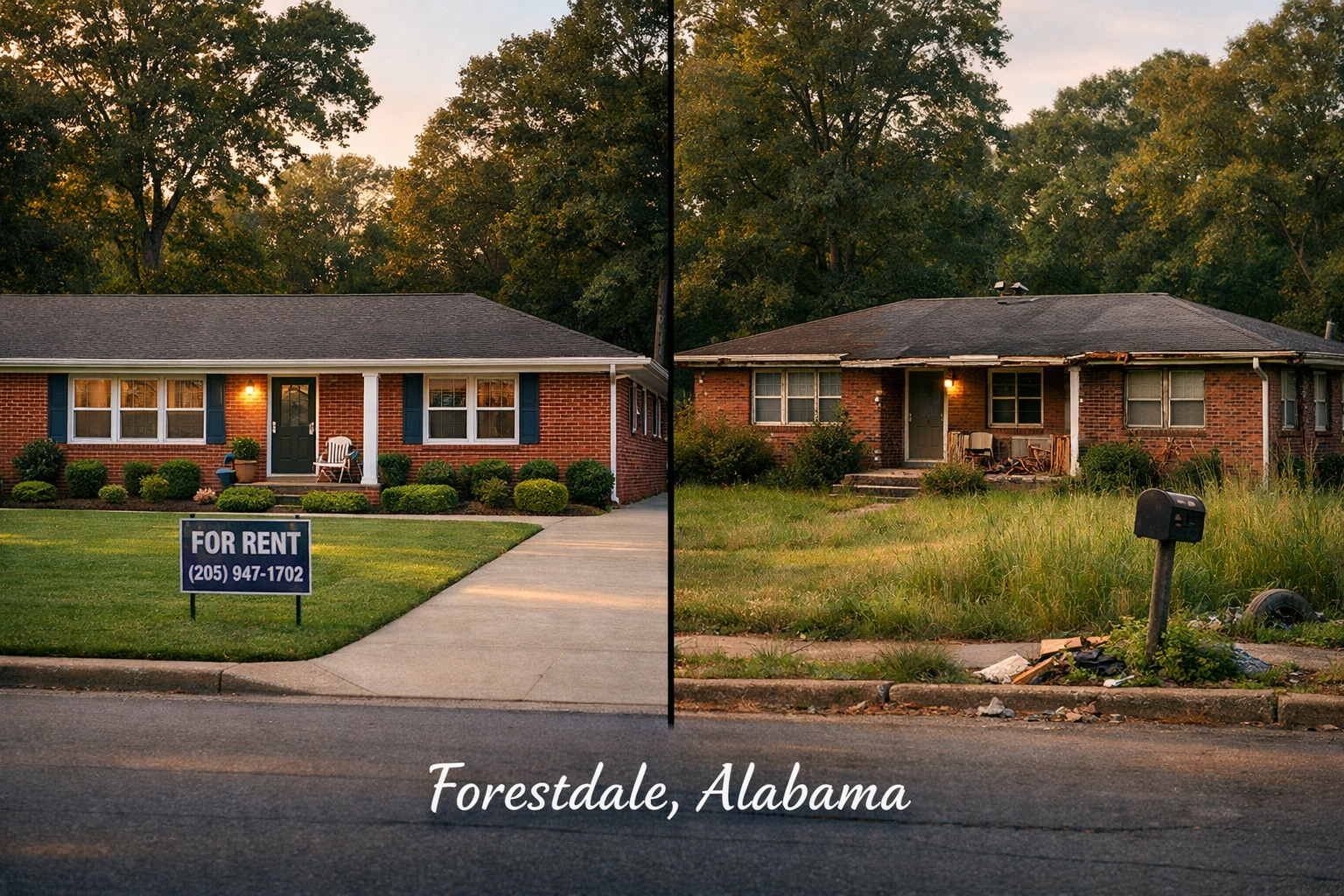
The “Pocket” Reality of Property Values in Forestdale, Alabama
Key Takeaways
- Pocket boundaries can appear within a few blocks, so value decisions should rely on street-level cues and condition tier rather than a single ZIP-wide median in Forestdale.
- Closed sales and active listings measure different parts of the market; tracking both by street and subdivision in 35214 helps identify where properties move faster and where they take longer.
- Comparable sales that align on renovation scope, functional layout, lot usability, and surrounding block condition tend to support cleaner valuation conclusions than the closest sale on a map.
- Public projects and corridor conditions can shift demand toward certain pockets, with trail access tied to the Five Mile Creek Greenway and the Red Rock Trail System acting as recurring lifestyle inputs.
- Rental turnover and exterior standards influence pocket stability; consistent screening, rent-ready scope control, preventive maintenance, and inspection documentation help keep block appearance predictable when handled by Lease Birmingham.
Introduction
Property values in the Forestdale area behave like a patchwork, with results shaped at the street and block level. A “pocket” is a small area where the visible and measurable signals of value move together: consistent upkeep, predictable buyer interest, and comparable recent sales that support similar pricing. One pocket can signal stability through clean sightlines, maintained exteriors, and occupied homes, while a nearby pocket can signal higher risk through neglected yards, repeated vacancy cues, or disruptive property conditions. The difference matters because buyers react to what can be seen during a drive-by, and appraisers must anchor value to comparable sales that match both the house and its immediate setting.
Pocket behavior shows up when broad neighborhood labels fail to explain what buyers pay for a specific address. Sale prices can diverge when two nearby houses share square footage yet sit in blocks with different maintenance norms, different levels of reinvestment, or different exposure to nuisance conditions that shape buyer comfort. Some streets with long-term care keep a consistent baseline; other streets show deferred exterior maintenance that becomes contagious and drags down perception for nearby properties in the Forestdale area. That street-level contrast creates valuation friction, with pricing supported on one block and resisted on the next.
This article takes a street-by-street approach meant for owners protecting equity, buyers evaluating risk, and rental owners setting standards that hold up over time. The focus stays on how pockets form, how they can be spotted, and how market evidence should be read without treating a single zip-code snapshot as a full answer. A pocket lens guides rental oversight decisions because consistent standards can reinforce a stable block pattern, while turnover and visible neglect can amplify decline in the Forestdale area, a focus that aligns with how Lease Birmingham operates. The sections that follow break the topic into practical pieces that connect curb signals, sales records, rental dynamics, public investment, and block-level evaluation methods.
Defining The “Pocket” Reality In Forestdale
Street-Level Variation In Condition, Demand, And Pricing
A pocket market shows up when pricing signals change across very short distances, even when houses share the same era, similar construction, and similar square footage in the Forestdale area. Median metrics can look steady at a broad boundary and still mask wide spreads created by blocks that present different levels of upkeep, vacancy risk, and nearby property condition. Recent public market dashboards already show how boundary selection changes the signal: Redfin reported a December 2025 median sale price of $161,225 for Forestdale and an average 121 days on market in the same period.
Comparable matching becomes the pressure point in a pocket market because appraisal support depends on closed sales that reflect the same buyer reaction as the subject address. Fannie Mae requires a minimum of three closed comparable sales in the sales comparison approach, a rule that shapes how value is anchored when pockets differ. A shortage of truly comparable sales can force the use of less similar properties, provided the appraisal documents the reasoning and explains why those sales were used.
Street-level variation can cause a mismatch between the closest sales and the most credible sales, which is where pocket boundaries become costly for owners and buyers. Distance alone does not settle the problem because the same guidance expects specificity in proximity, measured in miles with a directional indicator, which keeps the discussion concrete in the appraisal report. Recency adds another layer, since comparable sales that closed within the last 12 months should be used when available, even though the best indicator of value may not always be the newest sale.
How Pocket Boundaries Form Over Time
A pocket boundary forms when reinvestment stays consistent on one block and breaks down on the next block, creating a visible divide that persists through multiple sale cycles in the Forestdale area. Long-term tenure tends to support repeated maintenance decisions that stay visible from the street: roofing and gutters that remain intact, paint that stays fresh, fences that remain upright, yards that remain trimmed. Deferred maintenance creates the opposite pattern, where small failures stack up across seasons and become a shared visual signature of the block. That block signature influences how a buyer judges risk before scheduling a showing and how an appraiser frames neighborhood context during analysis.
Deferred maintenance clustering has support in housing research that isolates condition as the channel behind nearby price impacts. A Federal Reserve Bank of Boston working paper reports evidence that foreclosure spillovers can be explained entirely by property condition, linking price effects to neglect rather than to foreclosure status alone. Condition-driven spillovers fit the pocket reality because they operate at close range, where one neglected structure can alter expectations for the immediate surroundings. The same mechanism keeps pocket boundaries sharp when multiple properties on a short stretch drift into visible neglect at the same time.
Boundaries harden when sales activity begins to separate into different condition tiers within the same broader market area, which changes the set of comparables available for future appraisals in the Forestdale area. A block that produces repeated low-condition sales builds a record that can pull nearby valuations toward that tier when similarity becomes hard to defend. A block that maintains consistent exterior standards produces a different record, with sales that tend to support a higher baseline when the properties remain comparable in condition and setting. That gap can widen without any single dramatic event, driven by cumulative decisions made over years at the parcel level.
Pocket Signals Seen From The Curb
Curb signals create the first credibility test for a pocket because they show maintenance behavior without requiring interior access in the Forestdale area. Straight roof lines, intact flashing, functional gutters, downspouts that carry water away from the foundation, and consistent exterior paint signal ongoing care. Driveways with stable edges, yards that drain without standing water, and fences that remain aligned signal that exterior systems have not been ignored. Neighboring properties matter in the same glance, since block consistency influences whether the subject property looks typical for its immediate setting.
Site and neighborhood conditions can create market resistance that is recognized in appraisal guidance, which ties curb signals to value outcomes without speculation. Fannie Mae requires the appraiser to comment when a site has adverse conditions or when there is market resistance because the site is not compatible with the neighborhood or the competitive market, then assess the effect on value and marketability. That requirement makes curb-level issues more than cosmetic, since adverse site conditions and incompatible surroundings must be confronted in analysis. The same logic elevates block-level nuisances from “background noise” into conditions that can influence marketability.
External influences outside the lot line can still translate into measurable depreciation, a concept addressed directly in appraisal literature. The Appraisal Institute discusses external obsolescence as value loss driven by factors outside the property, which aligns with pocket effects created by nearby conditions that the owner cannot cure through interior renovation alone. A pocket with stable surroundings reduces the likelihood that an otherwise solid house gets discounted for reasons unrelated to its own condition. A pocket with recurring external negatives can face discounts even when a house presents well, since the market prices the setting along with the structure.
Location And Built Environment Drivers
Unincorporated Jefferson County Service Context
Service expectations change when governance and enforcement sit at the county level rather than a municipal level, a defining condition for the Forestdale area. Code enforcement functions are described by Jefferson County as work aimed at keeping unincorporated communities in compliance with county ordinances and applicable state requirements, which frames how complaints, inspections, and follow-up may be handled. A county-centered structure can create uneven outcomes street to street when the surrounding blocks rely on voluntary upkeep and private reinvestment to maintain consistent appearance.
Law enforcement coverage in unincorporated areas is identified by the Jefferson County Sheriff’s Office as a core duty, which shapes realistic expectations about who responds and how patrol resources are organized in the Forestdale area. Dispatch and call processing for many public safety responses run through the county’s consolidated 911 system, which states it serves all unincorporated areas and most cities in Jefferson County, adding another layer to how service delivery is routed. Street-level value signals can reflect how residents interpret reliability of response, since perceived gaps in service can change buyer comfort during evening drive-bys, open houses, and longer marketing periods.
Fire protection is commonly organized through local districts in unincorporated parts of Jefferson County, with the Forestdale Fire District operating stations and board governance tied to the community served in the Forestdale area. Local district operations matter for property values because the presence, proximity, and familiarity of responders can influence insurance shopping, buyer perception, and renovation planning without relying on broad metro assumptions. Public-facing information about station locations and district operations gives owners a concrete starting point for evaluating practical coverage rather than guessing based on a ZIP boundary.
Housing Stock, Architecture, And Lot Patterns
Housing tenure provides one of the clearest baseline indicators for how blocks sustain upkeep patterns over time, which connects directly to pocket behavior in the Forestdale area. The U.S. Census Bureau QuickFacts page reports an owner-occupied housing unit rate of 69.0% for Forestdale CDP across the 2020–2024 ACS period, placing owner occupancy in the foreground for neighborhood stability discussions. QuickFacts reports a median value of owner-occupied housing units of $164,000 for the same period, a figure that provides context for how condition and block perception can move an individual address above or below typical expectations.
Comparable selection becomes cleaner when homes share construction era, layout logic, and functional utility, which means architecture matters even when two houses sit close together in the Forestdale area. One-story living, split-level configurations, basement presence, carport versus enclosed parking, and room count balance influence buyer demand because these traits shape daily use, renovation scope, and financing appeal. Lot profiles matter in the same way because narrow frontage, deep backyards, corner exposure, and irregular parcel geometry change privacy, noise exposure, and usable outdoor space, conditions that buyers price even when the interior is updated. Appraisal support tends to be stronger when comparable sales share these physical traits, since the market prices layout and site features in ways that do not always translate through simple price-per-square-foot comparisons.
Listing inventories in 35214 provide a practical lens on what buyers encounter when shopping the area, which indirectly shapes how sellers must present condition and how appraisers find relevant matches in the Forestdale area. Realtor.com’s ZIP code page for 35214 reports a median listing home price of $128,000 and an average of 67 days on market for active listings, a signal of slower movement that increases the influence of curb appeal and block-level perception during repeated showings. Properties that align with the dominant buyer needs in a given pocket tend to sell with fewer price resets, since the buyer pool is narrower when layout compromises require major renovation decisions. Lot usability becomes a deciding factor in many transactions because buyers weigh outdoor function, parking, grading, and tree cover as lifestyle inputs that can be expensive to change after closing.
Topography, Drainage, And Access Factors
Drainage and floodplain exposure can create sharp value differences inside a single ZIP code when creek proximity and grading patterns change from street to street in the Forestdale area. The ATSDR/CDC land reuse case study on Five Mile Creek describes the waterway as a 45-mile system affected by industrial contaminants and floods, reinforcing why flood history and watershed conditions remain relevant to buyer risk perception in nearby communities. USGS work on Fivemile Creek notes the watershed lies north of Birmingham and includes areas shaped by industrial and urban land uses, context that supports careful attention to runoff patterns and site history when evaluating properties in the Forestdale area.
Stormwater infrastructure affects usability in ways buyers notice quickly, since standing water, ditch erosion, and recurring muddy yards signal ongoing maintenance burdens in the Forestdale area. Jefferson County’s MS4 annual report references the Upper Five Mile Creek watershed basin and describes land use at sampling locations as undeveloped and low-density residential, a combination that often relies on ditches, culverts, and natural conveyance rather than full curb-and-gutter buildouts. Site constraints tied to slope and drainage influence renovation choices because additions, driveway changes, and grading corrections can cost more than interior finishes, pushing buyers to discount properties where exterior water management looks unresolved.
Access patterns influence buyer willingness to pay because commuting convenience, corridor noise, and traffic exposure can change within a short distance in the Forestdale area. The Alabama Department of Transportation General Highway Map for Jefferson County documents the arterial network that includes I-22 and U.S. 78 in the area, supporting objective discussion of connectivity without relying on marketing language. Road adjacency can lift demand for buyers who prioritize quick routes, yet the same adjacency can depress demand on blocks exposed to higher noise and cut-through traffic, producing another pocket boundary driven by the built environment. A pocket analysis that accounts for creek corridors, slope, and road hierarchy produces cleaner expectations than a ZIP-wide average because physical context changes faster than the boundary lines on a map in the Forestdale area.
How Street-Level Values Get Set
Comparable Selection In A Pocket Market
Street-level value depends on whether closed sales used as comparables reflect the same buyer reaction to the same type of setting, a recurring challenge in the Forestdale area. A sale that sits close on a map can fail as support when block conditions differ, since the market can treat visible upkeep, vacancy cues, and nearby property condition as part of what is being purchased. Neighborhood analysis in the appraisal process requires boundaries, characteristics, and factors that affect value and marketability, which places pocket boundaries inside the valuation workflow rather than leaving them as informal opinions.
Proximity has to be reported with precision, which matters when pocket edges sit within a short drive of each other in the Forestdale area. The appraiser must report distance in miles with a directional indicator and measure that distance as a straight line between properties. A straight-line distance can make two sales look interchangeable even when the route between them crosses a pocket boundary that changes how a buyer experiences the block. Comparable selection becomes stronger when the sales share the same block-level signals that a buyer sees during drive-bys and at showings, even when that pulls the search outside the closest radius in the Forestdale area.
Minimum comparable requirements create a second constraint when turnover is thin inside a stable pocket in the Forestdale area. A minimum of three closed comparables must be reported in the sales comparison approach. Comparable sales that closed within the last 12 months should be used, with older sales permitted when recent sales are limited and the use is explained in the report. A shortage of truly comparable sales permits the use of less comparable properties when the analysis is documented and the reason for using them is explained, which is where pocket boundaries can show up as adjustments, commentary, or expanded search areas tied back to the Forestdale area.
Renovation Quality, Systems, And Functional Layout
Renovation outcomes influence value when the work changes the standardized condition and quality picture that the appraisal must report, with direct consequences for comparability in the Forestdale area. Condition and quality ratings must be selected on an absolute basis for the property itself, not chosen to match or compete with nearby properties. A clean presentation and new finishes can still leave a property in a lower condition tier if substantial deferred maintenance or defects affect safety, soundness, or structural integrity. Repairs that change the real condition of the structure tend to produce cleaner comparable matches than purely cosmetic upgrades in the Forestdale area.
Systems and core components shape appraisal comfort because the appraisal must address market resistance when improvements do not fit what the competitive market expects. Market resistance tied to adequacy of plumbing, heating, or electrical services, design, quality, size, condition, or related demand factors must be addressed for impact to value and marketability. Deferred maintenance can reach a point where financing constraints become part of the pricing environment, which pushes buyers toward discounted offers or limits the buyer pool in the Forestdale area. Loans secured by properties with a condition rating of C6 are not eligible for sale to Fannie Mae, with repairs required to reach at least a resulting minimum condition rating of C5 prior to sale of the loan.
Functional layout influences value when the market treats the design as inefficient or expensive to cure, which can persist even after renovations in the Forestdale area. Functional obsolescence includes loss in value tied to design features that the market sees as outdated or inadequate, with measurement often tied to cost-to-cure or value impact concepts used in appraisal practice. Layout limitations that buyers frequently price include bathrooms placed in ways that force traffic through bedrooms, kitchens that cannot accommodate modern appliance footprints without structural change, or circulation patterns that waste usable living areas. Renovation plans that correct function, not only surfaces, tend to reduce adjustment pressure in the sales comparison grid and support a tighter comparable set for a property in the Forestdale area.
Externalities Buyers And Appraisers Price In
Externalities affect value when forces outside the lot line change marketability, which can set pocket boundaries in the Forestdale area. Neighborhood analysis requirements in the appraisal process focus on boundaries, characteristics, and factors affecting value and marketability, a structure that captures corridor influence, land use conflicts, and block-level nuisances. The setting can overpower interior upgrades when a buyer anticipates recurring nuisances that cannot be cured through renovation spending on the subject property. Pocket separation becomes visible when the same house type sells differently across blocks that present different external conditions in the Forestdale area.
Traffic and highway noise can operate as a corridor effect because it is persistent and easy to notice during showings. FHWA material on noise effects identifies property values as an area of economic concern tied to highway noise. ALDOT maintains a highway traffic noise analysis and abatement policy, reinforcing that transportation noise is treated as a planning and mitigation issue tied to project development. A short change in distance from a corridor can change the lived experience of a block, which can translate into price separation across nearby streets in the Forestdale area.
Adjacent property condition and nuisance exposure can produce value loss categorized as external obsolescence when the negative influence sits outside the property itself. External obsolescence is driven by factors outside the property and presents a recognized challenge in valuation because the loss is not cured through improvements to the structure alone. Repeated vacancy cues, persistent neglect next door, or incompatible nearby uses can become part of the buyer’s risk pricing and the appraiser’s narrative about marketability. Pocket boundaries harden when those influences cluster along a corridor or within a short run of parcels, producing a different market reaction for addresses that sit inside that cluster in the Forestdale area.
Market Evidence From Sales And Listings In 35214
Interpreting Public Listing Data Without Overreliance On Medians
A median is a midpoint, not a promise that a typical block behaves like the midpoint, which matters when pockets inside 35214 move in different directions at the same time. Redfin reported a December 2025 median sale price of $140,000 for 35214, based on closed sales recorded on its platform. Realtor.com’s ZIP-level market page reported a median price of $117,500 for 35214 among active listings on its platform at the time of the report. A gap between median sale and median list can exist without contradicting either source, since one series tracks closed transactions and the other tracks active inventory with seller expectations.
Pocket behavior hides inside the mix of homes that actually close during the reporting month, since medians move when the mix of condition tiers changes. Redfin reported 47 homes sold in 35214 during December 2025, a count large enough to show activity yet small enough for the month’s mix to matter. Redfin reported that homes in 35214 sold after 111 days on market on average in December 2025, compared to 66 days during the same month a year earlier. A longer marketing window increases the influence of block perception, since buyers have more time to compare pockets and sellers face more pressure to compete on condition and presentation.
Platform-to-platform differences need to be dated and treated as separate lenses, not blended into a single number, since each dataset has its own inputs and definitions. Zillow reported an average home value of $138,193 for 35214, down 2.3% over the past year, using the Zillow Home Value Index model rather than a median of closed sales. Zillow explains the Zillow Home Value Index as a measure built from monthly changes in property-level Zestimates to capture value movement across geographies and housing types. Closed-sale medians, active-listing medians, and modeled value indices can all be useful, with the most reliable street-level picture coming from separating the dataset by time window, property type, and visible condition inside 35214.
Condition Tiers And Price Bands Using Closed Sales
Closed sales support condition tiers because they show what buyers paid after inspections, negotiations, and financing constraints, which turns “asking” into a verified outcome inside 35214. A practical tier system separates distressed, standard, renovated, and expanded homes using visible condition, major system status, and functional utility rather than relying on marketing language. Fannie Mae publishes standardized condition and quality rating definitions used in appraisal reporting, creating consistent terms that distinguish well-maintained homes from properties with significant deferred maintenance. Those definitions support a cleaner read on closed sales because a renovated kitchen does not erase roof, foundation, mechanical, or safety issues that keep a property in a lower condition tier.
Price bands usually widen when square footage, bed-bath count, and renovation scope move together, which can be seen in recent closed-sale displays tied to 35214 and nearby Forestdale pockets. Redfin’s 35214 housing market page shows a sale on January 28, 2026 at $265,000 for a 5-bedroom, 3-bath, 2,639-square-foot house, indicating how expanded living area can sit in a higher band within the same ZIP. The same page shows a sale on February 6, 2026 at $142,000 for a 3-bedroom, 2-bath, 1,442-square-foot house, showing a lower band that can align with standard-size inventory when condition and layout match mainstream demand. A spread like that can coexist with a $140,000 December 2025 median sale price, since medians compress the full distribution into one midpoint for the month.
Distressed tiers influence the entire comparable pool because low-condition sales can become the most available anchors when turnover concentrates in neglected pockets. A distressed tier usually includes properties with visible exterior neglect, missing finishes, long-deferred repairs, or signs of water intrusion that buyers treat as scope risk, which can reduce the number of financed buyers able to compete. A renovated tier tends to earn stronger demand when the work goes beyond surfaces and includes dependable mechanical systems, corrected moisture pathways, and consistent workmanship that photographs and inspection notes can support. An expanded tier tends to separate when additions feel integrated and functional, since extra space that reads as awkward or unfinished can still trade like a standard home even at higher square footage. A pocket market inside 35214 rewards this tiering approach because the same street can hold multiple tiers at once, which makes closed-sale review more informative than a single median.
Days On Market, Price Reductions, And Buyer Caution Signals
Days on market measures liquidity, and liquidity shifts quickly when buyers become selective about condition, block cues, and repair uncertainty inside 35214. Redfin reported that homes in 35214 sold after 111 days on market on average in December 2025, compared to 66 days during the same month a year earlier. Realtor.com’s ZIP-level market page reported a median days on market of 86 days for 35214 at the time of its report, reflecting a separate lens built from its own listing and transaction inputs. Longer marketing periods often create room for renegotiation and price adjustments, since sellers receive more feedback cycles and buyers gain leverage through time.
Presentation gaps commonly slow a listing even when the price looks aligned with recent sales, since buyers filter aggressively when condition risk shows up early. Photos that reveal stained ceilings, uneven floors, missing outlet covers, patchy exterior paint, or overgrown yards tend to signal deferred maintenance beyond a quick weekend fix, which can narrow the pool of serious showings. Repair friction increases when a buyer anticipates multiple contractor trades, unknown moisture sources, or older mechanical systems with limited service history, since uncertainty can feel like an open-ended budget line. Functional friction can create the same effect, since awkward bedroom access, limited bath layout, or constrained kitchens can reduce willingness to pay even after cosmetic updates. A pocket environment amplifies all of these, since a strong block impression can offset minor flaws while a weak block impression can magnify them inside 35214.
Block perception affects liquidity because buyers evaluate the full approach to a house, not only the interior, and that evaluation happens repeatedly during longer marketing periods. A well-presented home can still sit when adjacent properties show prolonged neglect, visible vacancy, or recurring nuisance cues, since buyers price the setting and the immediate surroundings as part of the purchase decision. Realtor.com’s ZIP listing page reported a median listing home price of $109,900 for 35214 and an average of 82 days on market for active listings at the time of the page snapshot, placing active-inventory expectations alongside the slower closed-sale tempo shown on other dashboards. The liquidity picture becomes clearer when closed sales are reviewed against listing history, since a long days-on-market path paired with multiple list-price changes often signals buyer resistance tied to either condition tier, pocket reputation, or both within 35214.
Rental Dynamics And Pocket Stability
Owner-Occupancy And Tenure Indicators
Owner-occupancy sets a baseline for how many occupied homes are lived in by owners rather than renters, which shapes how quickly a block’s appearance can drift when pockets change in Forestdale. The U.S. Census Bureau reports an owner-occupied housing unit rate of 69.0% for Forestdale CDP in the 2020–2024 ACS period. Price conversations in owner-occupied pockets often anchor to the asset side, since the Census Bureau reports a median value of owner-occupied housing units of $164,000 for Forestdale CDP in the 2020–2024 ACS period. Rental expectations exist in the same dataset, with a median gross rent of $1,203 reported for Forestdale CDP in the 2020–2024 ACS period.
Tenure matters because a pocket that stays stable year to year tends to show fewer abrupt shifts in yard condition, exterior storage habits, and curb-level clutter that buyers notice during drive-bys in Forestdale. The Census Bureau reports that 90.2% of persons age 1+ in Forestdale CDP lived in the same house one year earlier in the 2020–2024 ACS period. A one-year stay metric does not label a street as “safe” or “high value,” since pockets can still diverge based on reinvestment and nearby neglect. That metric does support a practical screening step: blocks with low churn cues often have more predictable seasonal maintenance patterns, which reduces pricing friction when buyers compare similar houses across Forestdale pockets.
Owner-occupancy and tenure indicators work best when used as a map overlay rather than a conclusion, since the pocket reality means one subdivision can outperform another inside the same ZIP. Public data gives a starting point, while the street view delivers the confirmation, since buyers price what they can verify on approach. A stable-appearing block with consistent roofs, trimmed sightlines, and occupied driveways can exist beside a block where vacancy cues show up repeatedly, even when both sit inside Forestdale. A pocket evaluation stays grounded when owner-occupancy and tenure data guide where to look, while curb and sales evidence decide what the market is rewarding on that street.
Rental Concentration, Turnover, And Visible Wear
Rental supply inside 35214 provides a working picture of what renters can choose from and what owners compete against, which matters when pockets are trying to hold a consistent standard across Forestdale-adjacent streets. Zillow’s rental market summary for 35214 lists an average rent of $1,225 for all bedrooms and all property types, last updated February 5, 2026. Zillow’s same summary lists 54 available rentals in 35214 at the time of that update. A wide price range can signal a mix of condition tiers and property types, with Zillow listing a 35214 rental price range of $600 to $2,550 in that summary.
Turnover pressure often shows up when a pocket has enough competing rentals that tenants can move without changing school patterns or commuting habits, which can keep churn localized inside the Forestdale market. Zillow reports a month-over-month increase of $25 and a year-over-year change of -$5 for the 35214 average rent in its February 5, 2026 update. Asking-rent indices can show a slightly different view because they control for the mix of listings, with Zillow reporting an average rent of $1,242 for 35214 as of December 31, 2025 on its housing market page. Those two views are still useful together because pocket variation often appears as inventory mix changes, where a few renovated rentals entering the market can lift the asking-rent view while older stock holds the average closer to the prior month in 35214.
Visible wear becomes a pocket signal when it repeats across multiple parcels, since buyers treat repetition as a neighborhood pattern rather than a one-off event in Forestdale. Frequent turnover can leave a trail of small exterior issues that stay unresolved between move-outs, such as loose handrails, broken screens, damaged fascia corners, and patchy paint touch-ups that stand out on a street of brick ranches. A block can tolerate one neglected yard; a cluster of them changes how the entire pocket is priced because the approach experience becomes the story. A rental-heavy pocket can still present well when standards are consistent across owners, yet inconsistent care tends to show up faster on exterior surfaces than interior finishes, which is why pocket boundaries in Forestdale are often visible from the curb.
Maintenance Standards As A Neighborhood Signal
Maintenance standards act as a neighborhood signal because they create consistency that buyers can see quickly, which matters in a pocket environment where block impression often determines whether a showing becomes an offer in Forestdale. A rent distribution with many listings near a similar price point can reflect competition among comparable rentals, with Zillow’s 35214 summary showing counts concentrated in the $1,100 and $1,200 ranges at the time of its February 5, 2026 update. Competition like that puts weight on exterior presentation, since renters touring multiple options in one afternoon filter heavily on cleanliness, safety cues, and visible maintenance before asking about interiors. Standardized maintenance prevents a rental from becoming the weak link on a street, which protects the pocket’s reputation when a buyer later evaluates the block for purchase.
A maintenance standard becomes more than aesthetics when enforcement and service expectations vary across unincorporated areas, leaving block outcomes tied closely to private upkeep in Forestdale. Jefferson County describes code enforcement as work that keeps unincorporated communities in compliance with county ordinances and applicable state requirements, which frames how property condition issues may be handled outside city structures. That context raises the practical value of consistent maintenance routines because a pocket can drift when repeated exterior issues go uncorrected for long stretches. A curb that stays clean, a yard that stays trimmed, and repairs that stay current reduce the time window where a property reads as unmanaged, which supports stronger buyer confidence across Forestdale pockets.
Buyer confidence follows patterns, not promises, so maintenance standards matter most when they hold through tenant changes, seasonal weather, and ownership transitions in Forestdale. A street where most parcels follow similar routines tends to keep a consistent baseline, making it easier for appraisers to support comparables and for buyers to feel that the block will not shift suddenly after closing. A pocket with uneven standards forces buyers to price uncertainty, since the next-door condition becomes a variable outside the subject property’s walls. Pocket stability improves when exterior condition stays predictable across rentals and owner-occupied homes, since the market reads predictability as lower risk when comparing streets inside Forestdale.
Neighborhood Signals Beyond The Property Line
Jurisdiction, Policing, And Response Expectations
Law enforcement coverage tied to unincorporated Jefferson County matters because the baseline agency differs from a city police department for many streets near Forestdale. The Jefferson County Sheriff’s Office describes an important duty as providing law enforcement services to the unincorporated areas of the county, while maintaining full law enforcement jurisdiction in all cities and townships within the county. Patrol operations are organized through patrol divisions that provide protection and service for county residents, including enforcement duties and police operations support. A pocket analysis should treat that structure as part of the setting because buyer comfort is influenced by how residents believe service actually works on their streets.
Emergency call routing shapes response expectations because the dispatch layer determines where a call goes, how it is triaged, and how it reaches field units serving streets around Forestdale. Jefferson County 9-1-1 states it serves all unincorporated areas and most cities and towns within Jefferson County, including the Jefferson County Sheriff’s Office and multiple fire districts. Text-to-9-1-1 is described by Jefferson County 9-1-1 as available for its territory, including unincorporated areas of Jefferson County. A valuation lens treats dispatch and jurisdiction as part of practical livability because repeated perceptions about response can become a neighborhood narrative that affects buyer hesitation on certain blocks near Forestdale.
Resident accounts about response times and neighborhood conditions can inform pocket boundaries when they are treated as viewpoints tied to a specific time, street, and situation, not as a universal claim about the entire area near Forestdale. A single story posted online may reflect an extreme event, an unusual call type, a misunderstanding about jurisdiction, or a moment when staffing was strained, so the value comes from patterns across multiple sources rather than one post. A credible approach treats each account like a data point that needs context: date, time of day, where the caller was, and which agency was involved. Public-facing agency descriptions supply the factual spine for what coverage exists, while resident accounts supply the lived experience layer that can explain why certain pockets gain or lose buyer confidence.
Lighting, Roads, And Recurring Nuisance Patterns
Street lighting affects pocket perception because a buyer can evaluate it instantly during an evening drive-through, then carry that impression into pricing decisions near Forestdale. Alabama Power provides an online process for reporting a streetlight that is out, flickering, or damaged. A block with multiple dark fixtures can feel neglected even when the houses are well kept, since buyers often link lighting to everyday comfort and visibility rather than to any single incident. A pocket with consistent lighting tends to present as maintained and coordinated, which can reduce the friction that shows up as longer marketing time or softer offers.
Road condition functions as a pocket divider because pavement quality, pothole frequency, shoulder erosion, and worn markings can change within a short distance around Forestdale. Jefferson County describes its Roads and Transportation Department as responsible for maintenance of roads, including paving and patching, along with signage and traffic signals. State-maintained routes introduce another layer, since ALDOT provides a “Report a Concern” pathway for road repair, debris removal, and sign or guardrail issues. Buyers notice rough approaches and inconsistent signage because those cues suggest uneven upkeep beyond the property line, which can dampen demand in pockets where the streetscape feels uncared for.
Recurring nuisance patterns shape pocket stability when they cluster around the same corners, rights-of-way, or vacant parcels near Forestdale. Illegal dumping, unmanaged trash set-outs, persistent yard debris, and prolonged vacancy cues often concentrate where visibility is low or where responsibility feels ambiguous between owners and public maintenance. Roadside debris and broken signage can act as a multiplier because it signals neglect to both residents and outsiders, then invites more of the same behavior. A pocket retains value better when nuisances are not allowed to become the visual identity of the block, since buyers price the full approach experience rather than isolating the subject house from its surroundings.
Resident Information Sources And Attribution Standards
Street-level research becomes reliable when it separates verified facts from interpretations about what those facts “mean” near Forestdale. Agency sources establish coverage and responsibility in a way that does not change based on personal experience, which makes them the correct starting point for jurisdiction and infrastructure questions. Jefferson County 9-1-1 states it serves all unincorporated areas and most cities and towns within Jefferson County, which clarifies where emergency communications support comes from. Jefferson County describes its Roads and Transportation Department responsibilities, which clarifies where to look when pavement, signage, or signals appear to be driving pocket differences.
Neighborhood forums and social groups can contribute useful pocket detail when every claim is treated as a dated observation tied to a specific location and when the language is preserved as an attributed viewpoint. A pattern of posts describing the same nuisance at the same corridor can signal something worth verifying, while one dramatic post should not be treated as a market-wide truth for streets around Forestdale. Bias shows up quickly in online discussions because people post more often after negative experiences, so a pocket assessment should treat them as a lead source rather than a decision source. Credibility rises when a post includes specifics that can be cross-checked through official responsibility maps, service contact pathways, or observable conditions during a site visit.
Public records and official service portals help convert street talk into verifiable signals that can be tied back to value outcomes near Forestdale. Jefferson County provides an Addressing function that can produce address verification for unincorporated areas under its jurisdiction, which supports clarity when boundaries are confusing. Infrastructure issues tied to lighting and state roads can be grounded through the official reporting pathways published by Alabama Power and ALDOT, which keeps the analysis anchored to sources that document responsibility. A pocket analysis becomes defensible when each claim about the neighborhood beyond the property line can be traced to an agency statement, a documented service responsibility, or a condition that can be observed repeatedly on the same block.
Public Investment And Development Signals
Five Mile Creek Greenway And Trail Access
Trail access can act like a neighborhood amenity that buyers and renters factor into daily routines, which shows up as stronger demand on blocks that feel easier to live in. Freshwater Land Trust frames the Red Rock Trail System as a countywide network and reports 160 miles “on the ground,” which signals scale that goes beyond a single trail segment. Access matters because it turns outdoor space into a repeatable lifestyle benefit, not a one-time feature that only gets noticed on closing day. Pockets that connect cleanly to trails tend to attract attention faster than pockets where reaching the trail requires an inconvenient drive or unsafe crossings.
Project status is easiest to judge when the open mileage is separated from the planned mileage and the managing entity states both figures clearly. Freshwater Land Trust reports 15.8 miles of the Five Mile Creek Greenway open to the public, with another 20 miles planned. That same Five Mile Creek District narrative ties the greenway to a rails-to-trails corridor purchased from CSX, which anchors the project to a defined right-of-way instead of a loose concept. A trail built on a continuous corridor supports a more predictable pocket effect because access points and connectors are easier to extend without requiring brand-new land assembly.
Long-range trail planning influences expectations because buyers watch what is already open and then price in what feels likely to expand. The Red Rock Action Plan is presented as a 15-year strategy to develop 19 miles of new trails and create a 36-mile loop through the metro, which shows a pipeline rather than isolated wins. A pipeline matters for the Forestdale conversation because pockets close to established recreation infrastructure often become easier to market when buyers want space, trees, and access without giving up connectivity. Blocks that sit within a short, straightforward ride or walk to trail access can show stronger liquidity than blocks that require driving and parking, even when the houses are similar on paper.
Transit And Institutional Projects
Transit investment becomes a pricing signal when it changes the daily friction of commuting, errands, and access to downtown employment, which can shift demand toward pockets that feel better connected. A federal grant of $25 million was announced for the Birmingham-Jefferson County Transit Authority to build a new operations and maintenance facility intended to modernize transit service in Birmingham. The same grant is described by BJCTA as funding construction of a new maintenance and operations facility tied to modernization efforts. Institutional projects like this tend to influence perception first, then values follow as service reliability and route improvements become visible in daily use.
Land acquisition tied to a specific corridor often signals a project moving from concept into execution, which can matter more than press coverage. BJCTA’s published Program of Projects includes “Land Acquisition Forrestdale Blvd Maintenance Facility” as a listed project item, signaling that acquisition activity has been planned and budgeted within the agency program. Project siting can influence nearby pockets through changes in traffic patterns, service vehicle presence, and perceived land use compatibility, which buyers evaluate during repeated drive-bys. A value-focused read treats land acquisition as a tangible milestone because it reduces uncertainty about whether a project will remain hypothetical.
Community reaction becomes part of the market signal when it shapes timelines, design revisions, and ongoing public visibility of the project. WBRC reported that BJCTA’s proposal for a vehicle maintenance facility in Forestdale drew criticism from some residents and prompted meetings to address concerns. Public debate does not equal a uniform market impact, since responses vary by distance, access routes, and how the final design addresses noise, screening, and circulation. Pocket analysis stays grounded when buyers track what is officially approved, what land has been secured, and what construction schedule becomes public, then compare that against block-level sales and listing behavior.
County Planning Documents And Corridor Direction
County planning documents influence value expectations because they guide where growth is encouraged, where it is constrained, and how new projects will be evaluated. Jefferson County states that the Forward Together comprehensive plan was adopted at a public hearing held on September 11, 2025. Planning language matters most in unincorporated areas because development outcomes depend heavily on county policy choices rather than a city’s neighborhood planning framework. A pocket lens treats the plan as a market signal because it frames what future land use conflicts may emerge along corridors and what protections may exist for established residential streets.
Corridor direction becomes clearer when policy statements are tied to implementation tools like zoning resolution updates rather than remaining inside a planning narrative. Jefferson County’s September 25, 2025 bulletin states that proposed zoning resolution amendments were intended to align development regulations with policies recently adopted in the Forward Together comprehensive plan, with provisions that include workforce housing, mixed-use and master planned developments, disaster resiliency, economic and fiscal impact analysis, sensitive areas and agricultural preservation, economic cluster districts, and transportation-oriented development. Those categories matter for pockets because they shape what can appear near residential blocks and what design and review expectations may apply when proposals come forward. A corridor that is guided toward mixed-use or employment clusters can create different spillover expectations than a corridor guided toward conservation or lower-intensity residential patterns.
Enforcement shows up when proposals are evaluated against plan policies, which turns planning language into a practical signal for owners watching neighborhood change. A Jefferson County Commission agenda document from November 6, 2025 records a Planning and Zoning recommendation of denial for a zoning request because the proposed district change conflicted with adopted policies of the county’s Forward Together comprehensive plan. That kind of documented conflict matters for property values because it signals how consistently the county intends to use the plan in decision-making. Pockets tend to hold value better when land use outcomes feel predictable to buyers, since unpredictability increases perceived risk and can soften offers even when the subject house is well renovated.
Pocket Mapping Methods For Owners And Buyers
Building A Street List From Recent Closed Sales
A pocket map starts with closed sales because the pricing is verified at the end of a transaction, which keeps the street list anchored to what buyers actually paid in 35214. Redfin publishes a “Recently Sold” feed for 35214 that updates frequently and provides a rolling set of closed sales to pull into a working list. A clean process begins by logging the sale date, sale price, living area, bed-bath count, and year built for each sale, while keeping notes on the visible condition shown in listing photos. Condition notes should stay specific and observable, such as roof age appearance, exterior paint condition, window condition, driveway condition, and signs of moisture staining.
County sources add a second layer because parcel and ownership records support consistent identification when streets, subdivisions, and similar names create confusion. Jefferson County provides a Real Property Search portal that can be used to look up parcel details tied to a property record, supporting a check against what a listing platform reports. Recorded instruments sit under the Jefferson County Probate Court Land Records office, which defines where recorded documents are maintained for the county. Landmark Web is described by Jefferson County as an official records search interface for subscribers who want online access to land records and filings, which can support deeper verification when needed.
Grouping turns a long list into pocket intelligence, since streets that behave alike begin to show consistent bands when the list is organized by subdivision and condition tier. A condition tier label stays useful when it is applied consistently across the list, separating distressed, standard, renovated, and expanded homes based on what the photos and property description show. Street groups should be kept tight enough that the surrounding blocks feel similar during a drive-through, since pockets can change quickly inside 35214 and within Forestdale. A street list becomes actionable when it shows which pockets produce repeatable outcomes and which pockets produce scattered outcomes that resist clean comparable matching.
Block Audit Checklist For Site Visits
A block audit should be treated like a repeatable inspection routine, not a casual drive-by, since street-level cues change with time of day and day of week. A first pass should focus on block consistency, looking for a uniform baseline of yards, exteriors, and visible occupancy rather than judging a single property in isolation. A second pass should be done during evening hours to observe lighting coverage, porch activity, and whether the block reads as settled or transient. A third pass should be done during peak traffic periods to observe corridor noise spillover and cut-through traffic behavior that can separate one pocket from another.
Exterior consistency checks should focus on cues that buyers notice fast and appraisers photograph when they appear to affect marketability. Roof lines, gutters, fascia, soffits, and downspout routing should be scanned for sagging, staining, and missing sections that signal water management problems. Driveway edges, yard grading, and low spots should be checked for standing water and erosion patterns that tend to recur after rain. Window condition, screen condition, porch stair stability, and handrail integrity should be noted because they influence perceived maintenance discipline across a block. Trash set-out patterns should be observed without guessing intent, focusing on whether debris looks temporary or persistent from one visit to the next.
Vacancy and nuisance exposure checks should stay concrete, centered on what can be verified without assumptions. Vacancy cues include accumulated mail, multiple flyers, covered windows, overgrown vegetation that remains unchanged across visits, and exterior items that suggest a long absence. Nuisance cues include repeated dumping spots, recurring loud mechanical noise sources, and clusters of neglected vehicles that stay in place across visits. A pocket evaluation stays sharper when each cue is logged with a date and time, since a one-time scene can mislead while a repeated pattern becomes a reliable signal for 35214 and Forestdale.
Risk Flags That Depress Pricing And Liquidity
Clusters matter more than isolated issues because the market prices repetition as a neighborhood trait, which is how pockets lose liquidity. Deferred maintenance becomes a pricing drag when multiple homes on the same block show the same unresolved exterior issues, such as roof neglect, peeling trim, broken windows, or persistent yard overgrowth. Visible abandonment cues tend to depress demand because buyers treat them as an ongoing risk that cannot be cured by renovating one house. The Cleveland Fed found that additional nearby properties that are vacant, tax-delinquent, or both can reduce neighboring home selling prices in its empirical analysis of neighboring home sale prices.
Recurring complaint patterns can be treated as a verification task rather than a rumor mill when the focus stays on repeatable conditions and official responsibility channels. Jefferson County describes Code Enforcement as working to keep unincorporated communities in compliance with county ordinances and applicable state requirements, which identifies the correct lane for certain property condition issues. HUD’s discussion of vacant and abandoned properties links these properties to declining property values, supporting the idea that visible abandonment cues influence market behavior beyond a single parcel. A pocket assessment gains credibility when it separates what can be observed repeatedly from what is only claimed, since value reacts more reliably to patterns that persist.
A risk flag list should stay tied to market consequences, since the goal is predicting whether a house will attract strong offers or stall through price reductions. Clustered deferred maintenance tends to show up in longer marketing times, weaker initial offers, and higher inspection-driven renegotiation risk because the buyer expects surprises behind walls. Recurring dumping and chronic exterior clutter tend to reduce curb confidence, which matters in 35214 where buyers often compare several streets in a short loop before deciding which pockets deserve a showing. Visible abandonment cues tend to compress the buyer pool because many buyers avoid blocks that look unstable, which can push demand toward the pockets that present a consistent baseline across Forestdale.
Lease Birmingham And Pocket Protection In Forestdale
Tenant Screening Built For Block-Level Fit
Tenant screening at Lease Birmingham is built around verifiable signals tied to payment reliability and prior rental behavior, which matters in a pocket market where one problem tenancy can disrupt a quiet block. Screening includes background checks, credit checks, employment verification, and rental history analysis. Rental history analysis focuses attention on patterns that show up again after move-in, including repeated late payment history, repeated lease breaks, and documented property care issues when those items appear in prior records. A pocket lens treats screening as the first control point because the tenant placed in a house influences exterior condition, neighbor interactions, and the frequency of avoidable maintenance calls.
Block-level fit means the tenant profile needs to match the physical realities of the house and the expectations already visible on the street in Forestdale. Household size relative to layout matters because overcrowding tends to accelerate wear on flooring, doors, plumbing fixtures, and HVAC systems, while outdoor habits matter on large lots where yard and exterior storage are visible from the curb. Screening conversations and document checks focus on matching the applicant to the property’s daily-use demands, not only approving an application on income and credit alone with Lease Birmingham. A screening file becomes more than a pass/fail decision when the notes show how the tenant will realistically operate the property without creating the curb-level decline that shifts pocket perception.
Consistency matters because uneven screening standards create uneven outcomes, which is how rental-heavy pockets get labeled as unpredictable. The same screening components are applied across properties so owner expectations stay consistent across the portfolio, which is how Lease Birmingham keeps decisions consistent. A consistent standard allows the leasing decision to stay tied to documented criteria instead of shifting with vacancy pressure. Pocket protection follows from repeatability, since the best predictor of street-level stability is whether each placement decision is made on the same measurable inputs.
Rent-Ready Standards, Preventive Maintenance, And Vendor Oversight
Rent-ready work at Lease Birmingham follows a sequencing discipline that starts with a condition check, then scopes repairs that affect habitability, durability, and presentation, then verifies completion before marketing starts. A vacancy workflow includes inspecting and photographing the property, assessing required repairs, and marketing the property to reduce vacancy time. Photo documentation at the start of the make-ready cycle creates a baseline that helps separate pre-existing wear from new damage, which protects both the property condition and the decision-making record. Pocket stability benefits when make-ready work is not rushed, since unfinished exterior details like fascia damage, peeling trim, and yard neglect become the first signals a buyer or neighbor notices on the street in Forestdale.
Preventive maintenance planning matters because many costly failures start as small exterior or mechanical issues that stay invisible until they become emergencies. Routine maintenance at Lease Birmingham includes scheduled inspections and recurring services that can include landscaping, HVAC upkeep, pest control, and seasonal checks. A preventive plan reduces the number of last-minute repairs that force rushed workmanship and patchwork fixes, which often show up as inconsistent exterior appearance from one house to the next. Pocket boundaries harden when neglected properties become visually distinct, so preventive routines are treated as a street-level protection tool rather than a discretionary expense.
Vendor oversight protects standards when work quality is controlled through approved trades and clear scope definitions. Vendor management at Lease Birmingham is handled through partnerships with qualified contractors and service providers, with a focus on consistent quality and timely repairs. Contractors proposed by an owner can be used when the contractor meets criteria and coordinates through Lease Birmingham, which keeps scheduling, scope, and quality controls aligned with the property plan. Oversight connects directly to pocket stability because repeated low-quality repairs tend to become visible quickly on exteriors, then buyers begin pricing that street as a lower-condition tier.
Inspections, Photo Documentation, And Owner Reporting
Inspection cadence at Lease Birmingham is treated as a control system for catching decline early, before it becomes a curb-level signal that drags a pocket down. Regular inspections are part of the service model and are used to confirm the property remains well-maintained. Routine inspections are paired with a focus on proactive maintenance planning, which supports early identification of roof leaks, drainage problems, trip hazards, and exterior deterioration that tenants may not report promptly. A pocket market rewards early intervention because visible exterior decline often spreads through perception faster than it can be repaired after the fact.
Photo documentation is used to make inspection findings actionable and to keep condition conversations grounded in evidence rather than memory. A vacancy process includes inspecting and photographing the property, which establishes a dated baseline before a new lease cycle begins. Photos tied to inspection checklists help track recurring issues, confirm completion of repairs, and identify whether a problem is isolated to one property or starting to show up across multiple rentals on the same street in Forestdale. A documentation-first approach also improves vendor accountability because the scope is tied to visible conditions and completion can be verified without guesswork.
Owner reporting at Lease Birmingham is built around recurring financial visibility and a maintenance activity record that supports decision-making without forcing owners to chase details. Monthly reports can detail income, expenses, and maintenance activity, which keeps performance and condition connected in the same review cycle. Access to detailed financial reports through an owner portal is part of the reporting structure, which allows an owner to track income, expenses, and overall performance in one place. Reporting works as pocket protection when it exposes patterns early, such as repeated service calls tied to a single tenant or repeated exterior issues that signal a property drifting out of the standard expected on that block.
Conclusion
Street-level evidence sets the ceiling and the floor for what a buyer is willing to pay, so value movement should be judged where it is created: the block, the approach, and the nearest truly comparable sales. Pockets form when the same cues repeat across several properties, which makes one stretch of road feel predictable while another stretch feels uncertain. A ZIP-level median can sit still while different pockets shift in opposite directions, which is why the most defensible read comes from pairing closed sales with what is visible from the curb. Decisions that ignore pocket boundaries tend to misprice risk, misread demand, and misjudge how quickly a property will move in the Forestdale market.
Liquidity follows clarity, so the strongest strategy is building a repeatable method that separates condition tiers and ties each tier to the streets where buyers consistently accept that level of finish. Closed-sale grouping by street and subdivision shows where comparable support exists, while a block audit shows whether the street still presents the same signals that produced those sales. A rental property that holds a consistent exterior standard protects the pocket’s baseline because neighbors and buyers react to what persists, not what was promised at move-in. Street-level discipline is the practical way to protect value stability because it connects reinvestment choices to the market’s actual behavior in Forestdale.
Consistent rental standards are one of the few levers that can be controlled directly when pocket boundaries are driven by visible upkeep and repeated tenant cycles, which is where Lease Birmingham fits. Tenant screening focused on documented reliability, rent-ready execution tied to verified scope, preventive maintenance planning, and vendor oversight are used to keep properties from slipping into the condition tiers that pull a pocket down. Inspections paired with photo documentation and clear owner reporting keep decisions grounded in evidence, which supports fast correction of issues that would otherwise become curb-level decline. Property management services that include maintenance coordination, inspections, and reporting are part of the operating model at Lease Birmingham.
Frequently Asked Questions (FAQs) – The “Pocket” Reality of Property Values in Forestdale, Alabama
1. What Does “Pocket” Mean For Property Values In Forestdale, Alabama?
A “pocket” is a small area where street-level conditions stay consistent enough that buyers react similarly, comparable sales line up more cleanly, and pricing outcomes cluster around a recognizable range.
2. Why Can Two Nearby Streets Produce Different Appraisal Comparables?
Comparable sales can fail as matches when the surrounding block signals a different market reaction, since proximity alone does not guarantee similar upkeep, vacancy cues, nuisance exposure, or buyer confidence.
3. Which Agencies Cover Policing And 911 Dispatch For Unincorporated Jefferson County?
Law enforcement services for unincorporated areas fall under the Jefferson County Sheriff’s Office, while emergency communications are routed through Jefferson County 9-1-1 for unincorporated areas and many municipalities.
4. Where Can ZIP 35214 Sales And Listing Trends Be Checked With Dates Attached?
ZIP-level market dashboards that publish dated trend views include Redfin’s 35214 housing market page for closed-sale and days-on-market views and Realtor.com’s local market pages for listing-side context.
5. How Can Closed Sales Be Grouped Into Condition Tiers Without Guesswork?
Tiering works best when each sale is tagged using observable cues from listing photos and descriptions, separating distressed, standard, renovated, and expanded homes based on scope, workmanship, systems confidence, and functional utility rather than marketing language.
6. Which Curb Signals Tend To Change Buyer Risk Perception Fastest?
Signals that shift perception quickly include roof and gutter condition, drainage and grading clues, exterior paint and trim integrity, window and screen condition, porch and stair stability, yard consistency across the block, and repeated vacancy cues visible from the street.
7. What Drainage And Watershed Factors Matter When Evaluating A Lot Near Five Mile Creek?
Watershed context matters because flood history, runoff pathways, and creek-adjacent site behavior can affect usability and long-term maintenance, so lot evaluation should consider topography, drainage flow, and nearby creek conditions documented in public environmental and watershed materials.
8. What Is The Current Status Of The Five Mile Creek Greenway?
Public project reporting states that 15.8 miles of the Five Mile Creek Greenway are open and another 20 miles are planned as part of the Red Rock Trail System.
9. What Is A Practical Method To Build A Street List From Recent Closed Sales?
A reliable method pulls a rolling set of closed sales, logs sale date, price, size, bed-bath count, year built, and visible condition notes, then verifies parcel details with county property records before grouping by street, subdivision, and condition tier.
10. What Rental Practices Help Keep A Pocket From Sliding In Appearance And Marketability?
Pocket protection tends to improve when screening reduces avoidable turnover, rent-ready work addresses durability and presentation before marketing, preventive maintenance prevents visible decline, inspections catch drift early, and documentation keeps repairs and standards consistent across lease cycles.